Paths through built landscapes
Buildings and routes can organize a landscape without becoming its sole subject. Follow how six painters use paths, boats, houses, and travelers to give space a readable structure. Their relationships to place differ: a possible farmhouse location, a Provençal color arrangement, Italian observation, and an imagined Italy should not be collapsed into one kind of scenic record.
Begin the journey ↓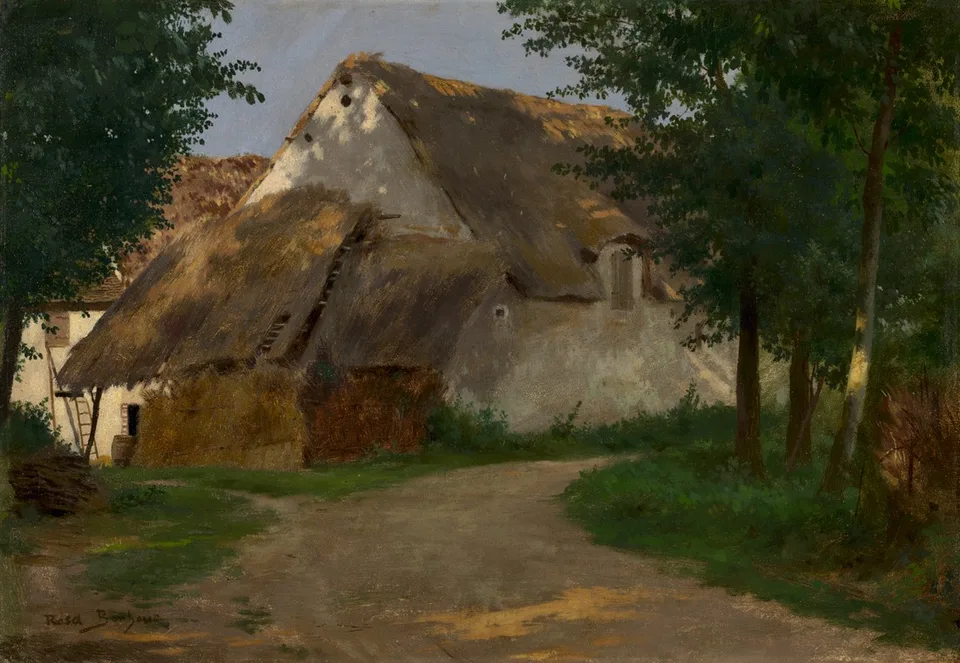
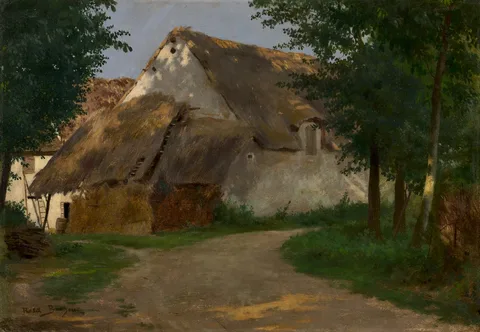
The curving approach
The path bends around a farmhouse and hides its continuation. The building feels situated, even though the museum only tentatively connects the subject with the Fontainebleau area.
Carry this question: What does the bend reveal, and what does it conceal?
Open the artwork ↗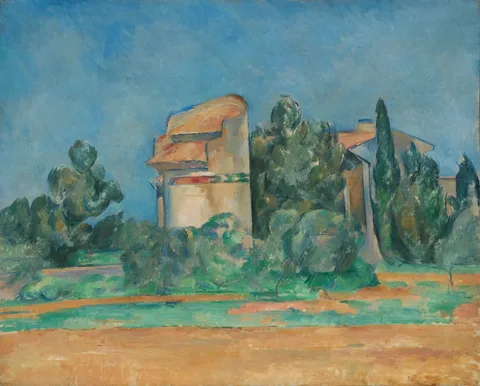
The pale tower
The tower organizes a different route: upward through orange earth, green trees, and blue sky. Large color relationships can establish structure without a densely described path.
Carry this question: How does the tower cross the horizontal bands?
Open the artwork ↗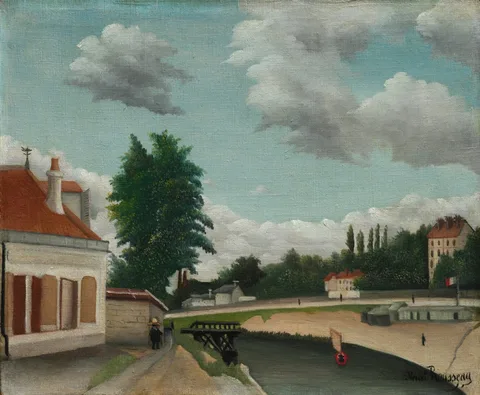
The small bridge
A small bridge supplies an explicit crossing between banks. Tiny figures and distinct houses make the organized suburban view inhabited while leaving its precise site uncertain.
Carry this question: Which shapes would become disconnected if the bridge vanished?
Open the artwork ↗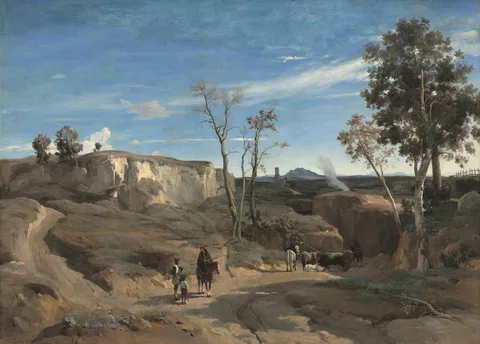
The bending track
Corot’s road joins a series of diagonal ledges. Outdoor studies informed the scene, but the finished painting carefully organizes the sequence from near travelers to distant terrain.
Carry this question: Follow one diagonal until another redirects your eye.
Open the artwork ↗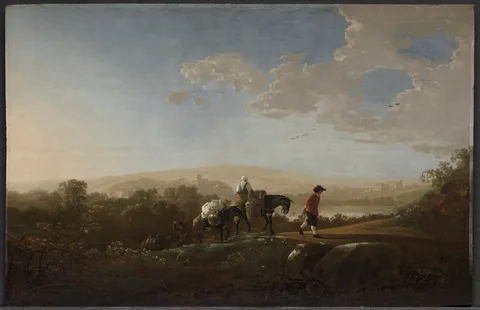
Hazy distant hills
Cuyp’s warm hills evoke Italy despite his never visiting it. Compare this persuasive distance with Corot’s travel-informed view without ranking visual conviction as proof of direct observation.
Carry this question: Which effects suggest distance without identifying a particular place?
Open the artwork ↗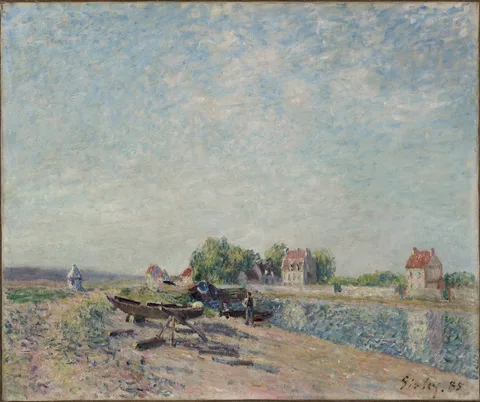
Boats at the bank
End at an engineered waterway where boats and houses occupy a narrow zone beneath abundant sky. Practical infrastructure and atmospheric attention belong to the same landscape.
Carry this question: How do the boats keep the bright scene connected with work?
Open the artwork ↗Read with the sources
Historical context follows the individual museum records linked on each artwork page. These routes make original comparisons of visible form; resemblance alone is not evidence of shared meaning or direct influence.
- The Farm at the Entrance of the Wood — museum collection record
- The Pigeon Tower at Bellevue — museum collection record
- Outskirts of Paris — museum collection record
- La Cervara, the Roman Campagna — museum collection record
- Travelers in Hilly Countryside — museum collection record
- Saint-Mammès, Loing Canal — museum collection record