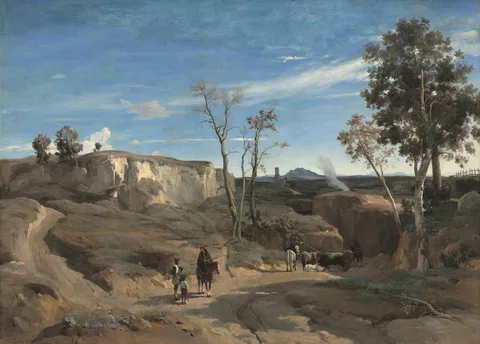
Golden air can suggest a distant country even when the painter never traveled to the place his landscape evokes.
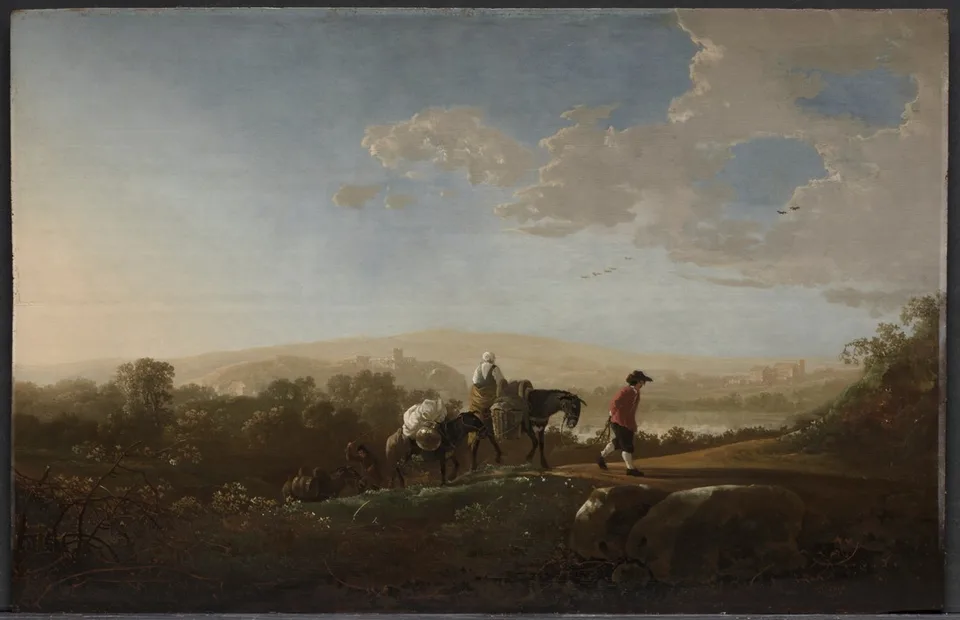
The travelers form a small procession along the ridge, their dark bodies set against a luminous distance. A red-clothed walker gives the group direction, while the loaded animals slow its rhythm. Below them, the foreground falls into shadow. Above, the expansive sky leaves the figures a limited but distinct place within a much larger world.
Cuyp never visited Italy, according to the museum, yet this panel evokes the hills, warm light, and picturesque structures associated with Italian landscape painting. That distinction makes the work a useful example of place constructed through an artistic language. It can feel convincing without recording a single witnessed location. Follow the softening hills and buildings toward the horizon, then return to the crisply silhouetted travelers. The contrast produces distance and a mood of serenity through choices of light and scale rather than through documentary exactness.
Cuyp did not visit Italy. The landscape’s Italianate character should be understood as artistic evocation, and its travelers cannot establish a documented journey or exact location.