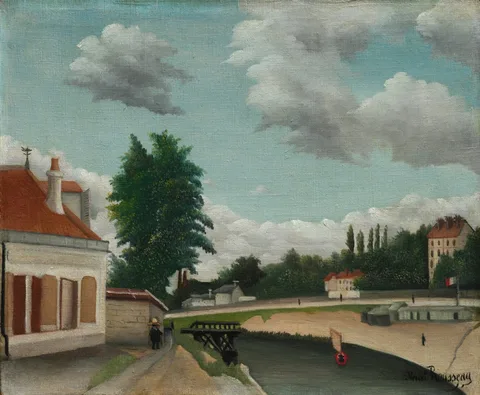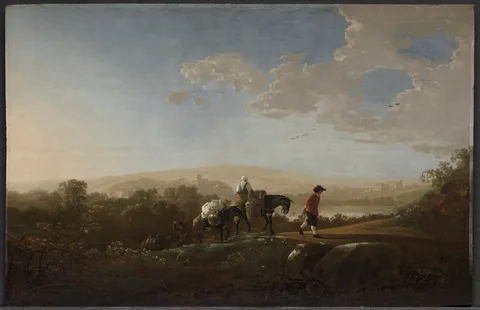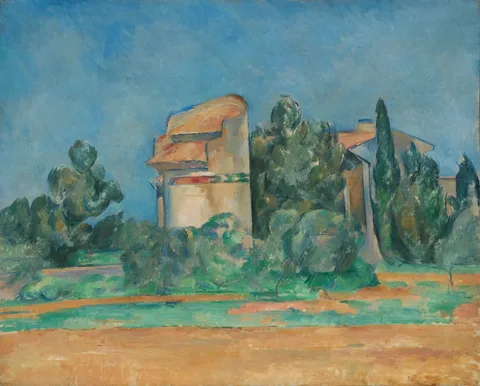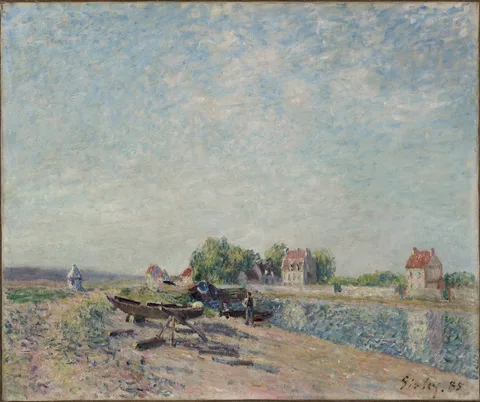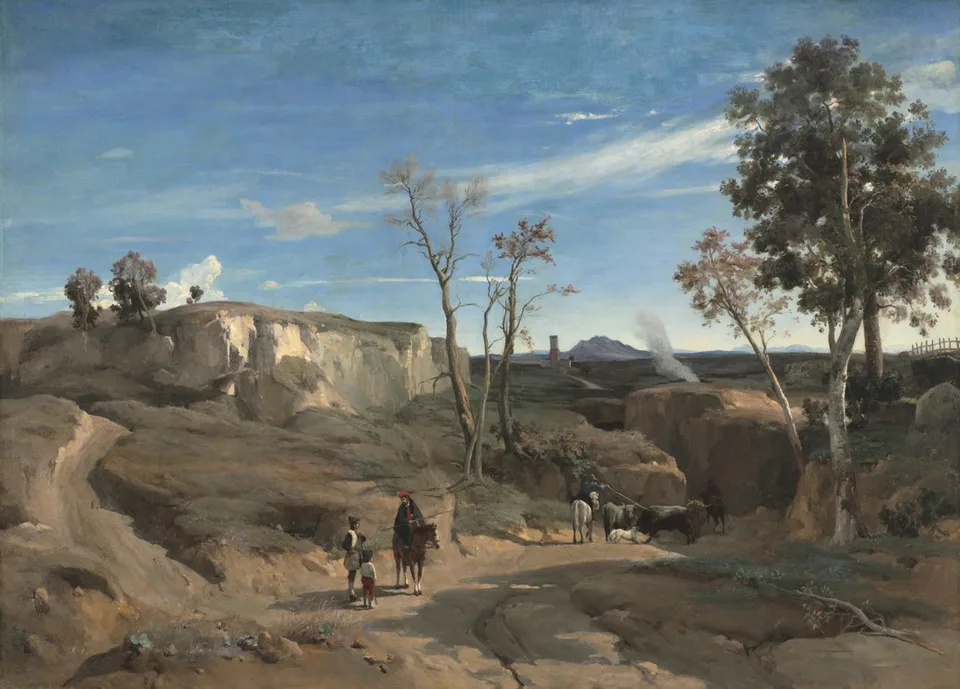
A traveler’s track and a sequence of rock ledges turn open countryside into an ordered route toward the distance.
The foreground path bends around rough earth and takes the small travelers toward a lower passage. Above it, pale rock faces and darker shelves form another set of routes across the picture. Slender bare trunks interrupt those horizontals, while a fuller tree on the right gives the scene an upright boundary. The sky occupies enough room to keep the structured ground from feeling enclosed.
Corot based this large painting on drawings and oil sketches made outdoors. The museum connects it with his years around Rome, from 1825 to 1828, and identifies the diagonal recession as characteristic of his early work. The view is therefore informed by observation but organized through a larger compositional plan. Following the roads, ledges, and trees reveals that plan more clearly than searching for a single picturesque landmark. The small figures give scale to a terrain whose shapes remain the principal subject.
Outdoor sketches informed the painting, but the finished arrangement is composed. Its small figures and distant structures should not be used to reconstruct an exact itinerary or event.