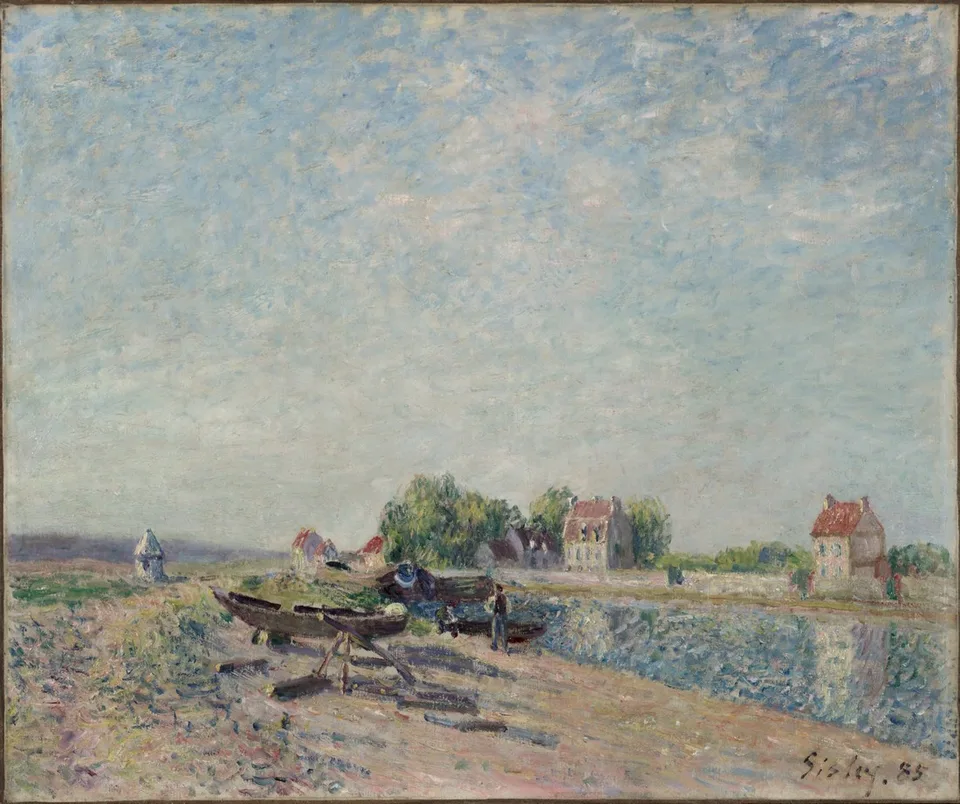
Small boats and houses occupy a thin strip beneath a sky whose broken marks spread light across the whole scene.
The land and water are kept low. Boats gather near the bank, and a few houses and trees form a modest line across the distance. Above them, the sky occupies most of the canvas. Its many short touches of blue and pale color make the light seem dispersed rather than concentrated in a single dramatic sunbeam. The same broken handling continues into water and path.
Sisley frequently painted Saint-Mammès during the 1880s. The museum locates it where the Seine and Loing are linked by a canal and notes that the area’s low rents mattered during his continuing financial difficulties. That practical context sits beside the painting’s visual ease. The waterway is working infrastructure, yet the scene also offers a study of outdoor brightness. Following the brushwork from sky to bank reveals how boats, buildings, and atmosphere can share one surface without receiving identical levels of descriptive detail.
The painting’s luminous calm should not be mistaken for evidence of the artist’s financial comfort. The small figures and boats do not establish a particular day’s commercial activity.