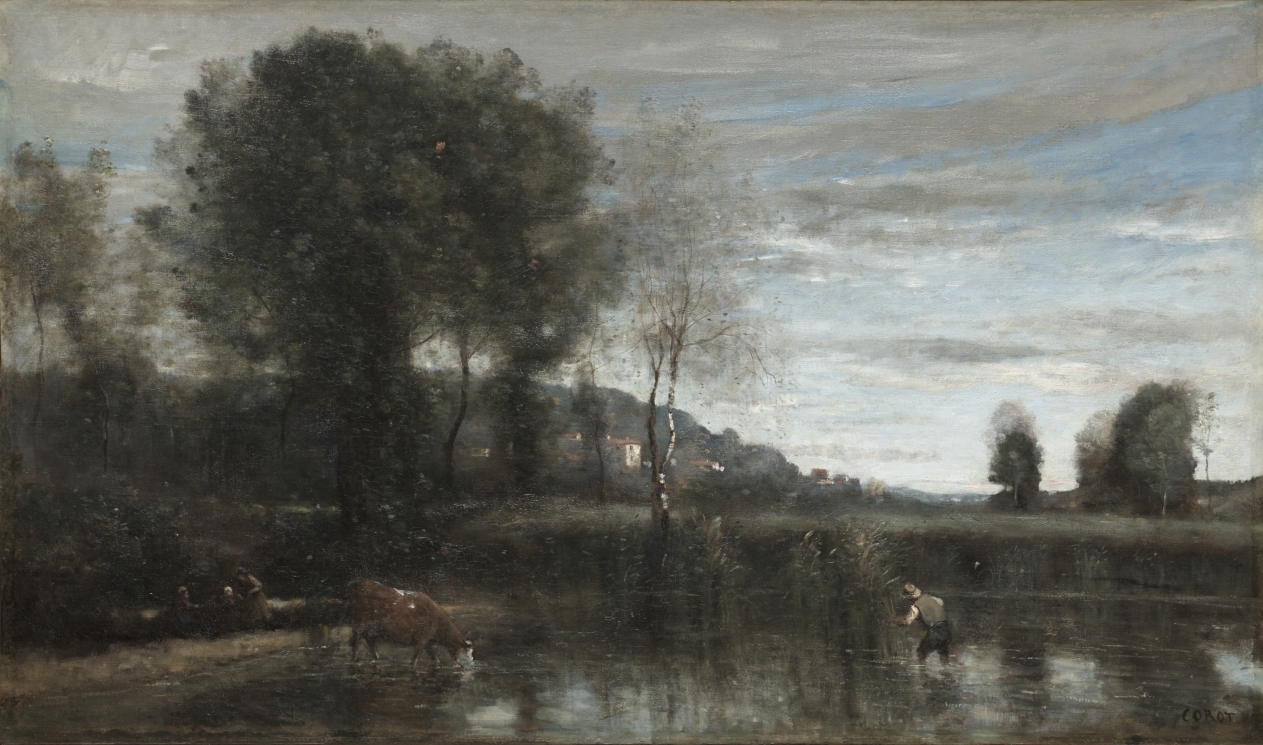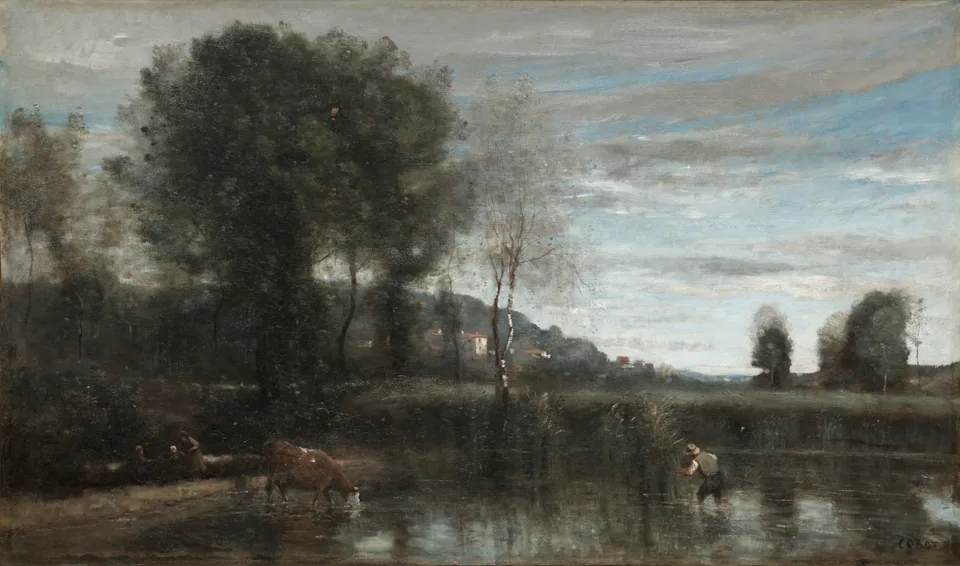
Soft edges make the familiar pond feel remembered, while tiny figures keep the landscape connected to ordinary activity.
The pond does not announce itself through spectacular color or a dramatic event. Its attraction lies in quiet transitions: dark foliage loosens into air, distant buildings soften, and the water holds broken reflections. A large tree mass at the left balances smaller isolated trees across the pond. Tiny figures and animals give the banks a lived-in quality without dominating the view.
The museum identifies a pond near Corot’s home at Ville-d’Avray, west of Paris, and places the painting within his late style. It describes a meeting of long observation and nostalgic memory. That context is useful because the soft treatment is not simply a failure to make things precise; it is central to the image’s character. Compare the firmer dark trunk with the dissolving distant shore. Different degrees of clarity allow the landscape to remain intelligible while suggesting an atmosphere that cannot be reduced to a list of sharply bounded objects.
The museum connects this late manner with memory, but we cannot recover a particular private recollection from the paint. The small figures’ exact tasks and identities are not established by the supplied record.