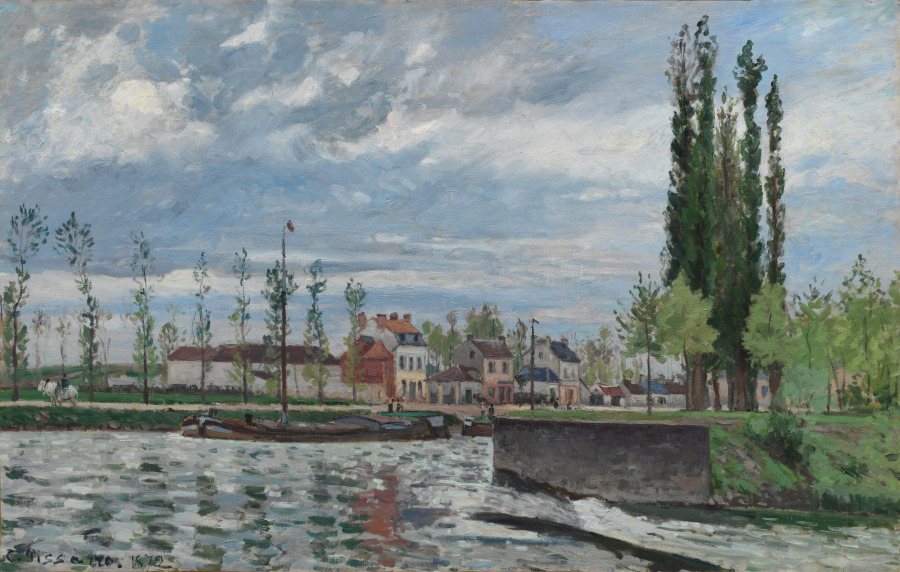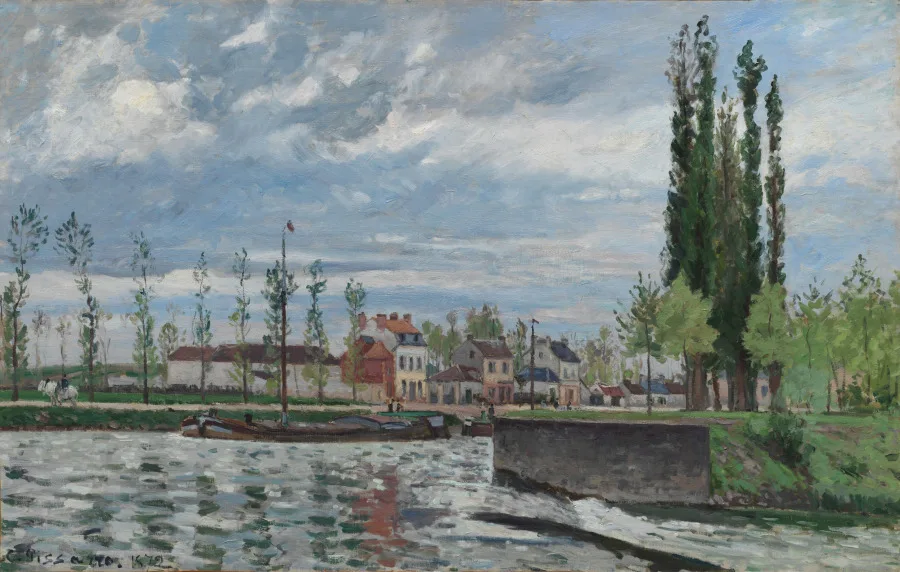
Water breaks into bright strokes while the lock holds firm, setting a flowing surface against a built structure.
The lock gives the water a shape to move around. Its dark rectangular face and diagonal edge contrast with the broken pale strokes running across the foreground. Beyond, a low settlement stretches beneath thin trees, while a taller group of poplars rises at the right. Pissarro makes this ordinary riverside setting engaging through the meeting of infrastructure, vegetation, and changing light.
The site was near the artist’s home at Pontoise, northwest of Paris. The museum connects the rapid handling with the emerging Impressionist practice of working outdoors, directly on canvas. It suggests that this painting may have been completed in a single session, but that remains a possibility rather than an observable fact. Compare the sharply intelligible mass of the lock with the sky and water: the same painting can establish durable structures and fleeting effects. The scene’s apparent immediacy depends on that balance, not on an absence of organization.
A possible single-session execution is a museum proposal. Rapid-looking marks do not independently prove speed or tell us the complete sequence of work, and the image is a composed view rather than a comprehensive survey of Pontoise.