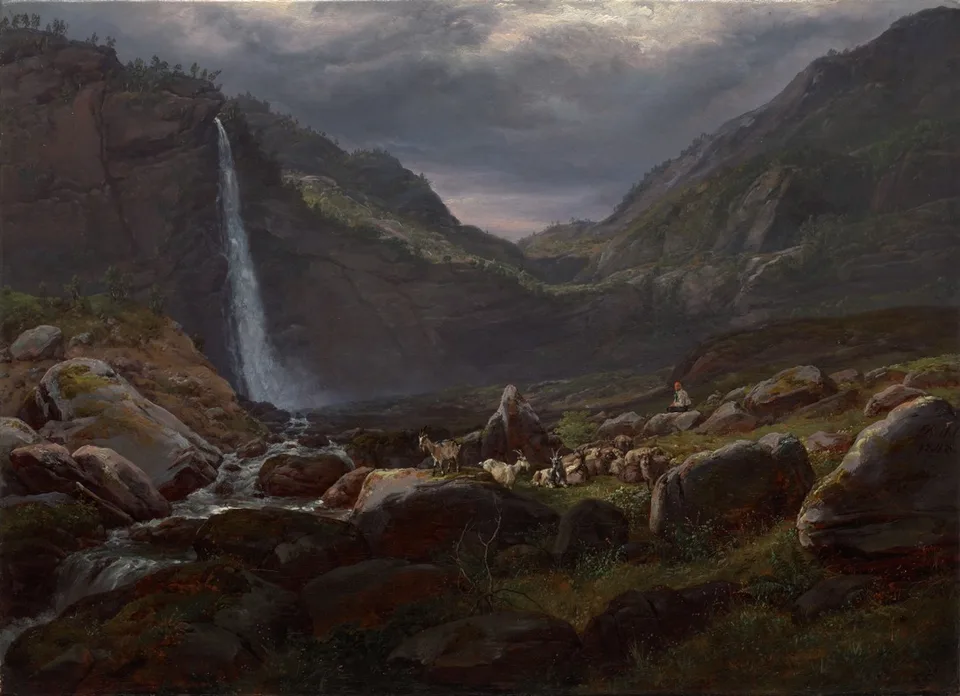
A tiny herd measures the height of a waterfall that also carried meaning for Norway’s developing national identity.
The waterfall is a narrow pale line against a huge dark cliff. Its water continues into the foreground through gaps among heavy boulders, linking a distant vertical drop with the near ground. A small herd and human figure sit between those scales. Without them, the rocks could be difficult to measure; with them, the valley becomes both immense and inhabited.
Dahl painted the Feige Waterfall at Lysterfjord in 1848. The museum places his Norwegian views within efforts to articulate a distinct national culture, giving the landscape a historical role beyond scenic admiration. That context does not require a flag or ruler to appear. A recognizable natural landmark can become an image through which people imagine belonging. The dramatic clouds and steep enclosing slopes intensify the effect, while the ordinary herding activity keeps the scene connected to practical life within the terrain.
The painting participated in national cultural representation, but it does not speak for every Norwegian experience. Its dramatic weather and scale are also artistic choices within a composed landscape.
What provides the clearest measure of the valley’s scale?
Practise looking at Feige Waterfall (Feigefossen), Lysterfjord, Norway →