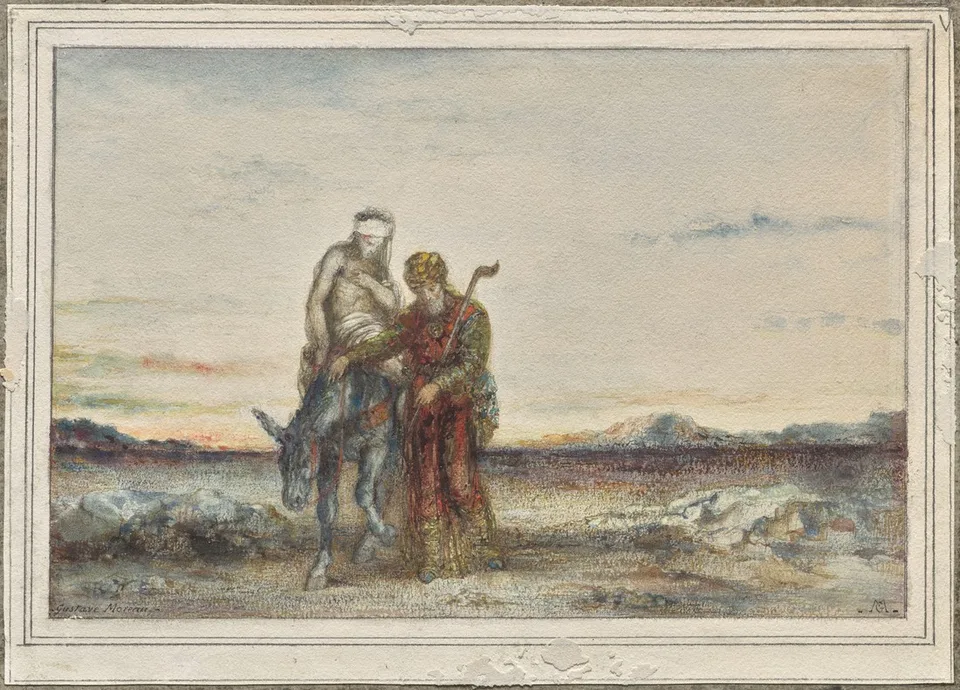
A horse and two closely joined bodies make assistance visible in a story about care across religious and social divisions.
The figures form a compact vertical group in a wide, open landscape. The wounded man’s pale body leans toward his helper, while the horse beneath him lowers its head. Around that close exchange, the horizon remains distant and the sky relatively empty. The emptiness gives the act of support room to become the center of attention.
Moreau represents the Good Samaritan, the New Testament story in which a traveler helps a wounded stranger despite religious and social differences. The museum identifies the chosen moment as the Samaritan giving up his own horse for the injured man. This is a practical transfer of comfort and mobility, not merely a sympathetic look. Dense layers of watercolor and gouache enrich the small group with jewel-like color. The result combines a familiar narrative of assistance with the otherworldly emotional tone associated with Moreau’s imaginative treatment of religious subjects.
The image interprets a biblical parable rather than documenting an actual roadside encounter. The figures’ ornate appearance should not be used as evidence for historically exact clothing or travel equipment.