Read the
Picture
An open collection
Egypt, probably Thebes, New Kingdom (1540–1069 BCE), Dynasty 18, reign of Amenhotep III (1390–1352 BCE) · Sculpture

Trial Piece Worked on Both Sides

Maker unrecorded · c. 1391–1353 BCE

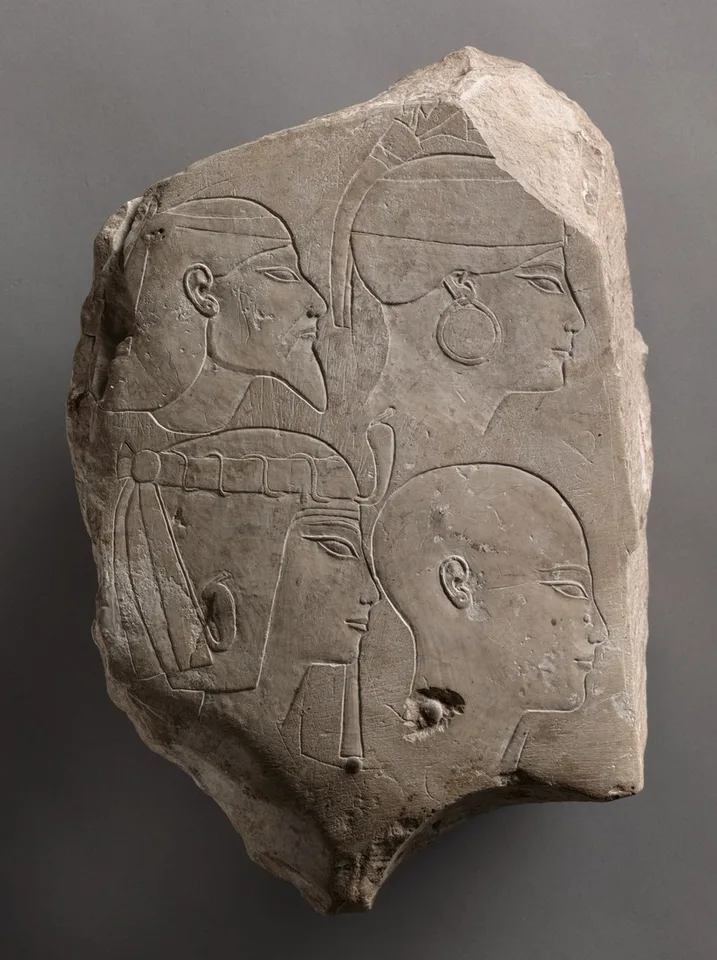
A roughly triangular limestone flake carries four incised profile heads arranged in two rows, all facing right. The upper left head has a pointed beard; the upper right wears a large hoop earring. Below are a figure with a patterned headdress and one with a smooth shaved scalp. Broken edges closely surround the carving.
100%

Drag to move · Pinch or +/− to zoom · Arrow keys to pan · 0 to reset

The Cleveland Museum of Art · 1920.1975 · Image: CC0Museum image ↗
A little context

Four profile heads share one broken stone, revealing how an artist varied hair, ears and facial outlines within a common format.

This limestone flake was worked on both sides, and the selected photograph shows four studies of heads. The museum interprets them through Egyptian representational conventions: a western Asian figure with pointed beard, a Nubian figure with large earring, a royal head and a shaved-headed priest. These are artistic types shaped by Egyptian categories, not neutral records of entire populations. The shared profile format makes differences of hair, head covering and facial outline especially conspicuous.

Look first at the two upper heads. A pointed beard lengthens one jaw, while a large circular earring gives the other a conspicuous open shape. Below, the patterned royal headdress contrasts with the priest’s smooth scalp. The studies fit tightly within the irregular stone, whose edges make the support feel provisional and close to the artist’s work. The reverse contains additional exercises of differing finish. This image therefore preserves evidence of making and comparison rather than a finished four-person gathering.

A careful reading

The museum’s ethnic identifications describe Egyptian artistic conventions, not objective definitions of people. The selected image shows one side; the different exercises on the reverse are outside this view.
Try your eye

Which feature distinguishes the upper right profile from the upper left?

Where this reading begins

  • Trial Piece Worked on Both Sides: collection record — The Cleveland Museum of Art. Identification, qualified cultural and maker attribution, materials, object-specific historical context, provenance and stated uncertainties; photograph independently inspected for visual observations. Museum record updated 2026-05-29; accessed 2026-11-14.

Our observations describe the supplied museum photograph. Historical identifications and context follow the cited collection record; interpretive limits are stated above. This is an independent guide, not a museum endorsement.

Image rights & attribution

Trial Piece Worked on Both Sides, c. 1391–1353 BCE. Egypt, probably Thebes, New Kingdom (1540–1069 BCE), Dynasty 18, reign of Amenhotep III (1390–1352 BCE). Limestone; overall: 34.4 x 24 x 7 cm (13 9/16 x 9 7/16 x 2 3/4 in.). The Cleveland Museum of Art, Gift of the John Huntington Art and Polytechnic Trust, 1920.1975

Individual API record marked CC0; checked 2026-11-14. CC0 1.0 dedication. Record date: 2026-05-29 05:28:54.508000. Museum print JPEG preserved unchanged in local originals; overview JPEG resized and recompressed from that same full frame; responsive WebP and zoom derivatives resized and recompressed; numbered annotation overlay separate from image.