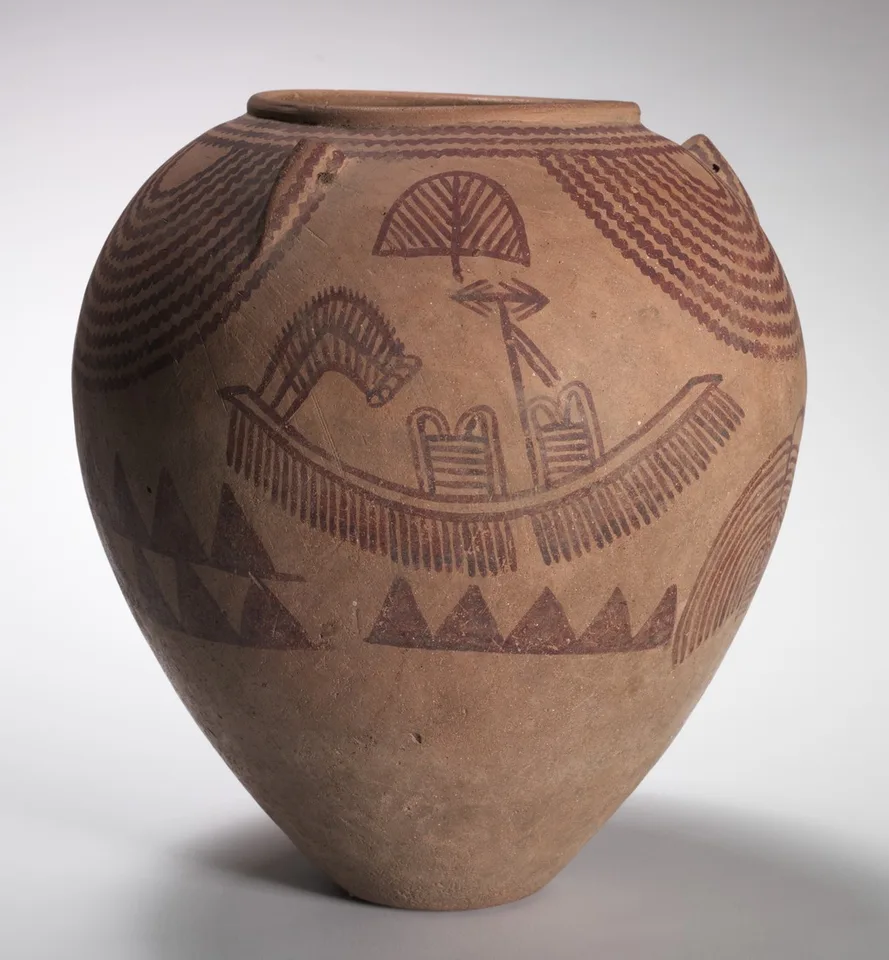
A curved boat and its many oars spread across a rounded jar, turning a small vessel into a compressed river landscape.
The museum reads the jar’s painted decoration as multi-oared boats moving through riverbanks with trees and aloe plants. Rows of triangles stand for desert hills. Made before Egypt’s dynastic period, the vessel presents a landscape through strongly simplified signs: a curved hull, many short oars, upright deck structures and plants. The image does not depend on a horizon line or a naturalistic view from one fixed position.
The swelling body of the jar helps the boat extend across the surface. Its upward-curving ends echo the container’s roundness, while the repeated oars make a dense fringe beneath the hull. Solid triangles establish a contrasting rhythm below. The museum places these scenes within the Nile’s central role in travel and communication, and also discusses later religious boat journeys. Those later traditions provide a broad history of the motif, but do not prove that this early jar depicts a particular deity or named funerary voyage.
The visible boat is secure, but a specific journey, passenger or deity is not identified. Later Egyptian religious boat traditions should not be projected automatically onto this Predynastic scene.