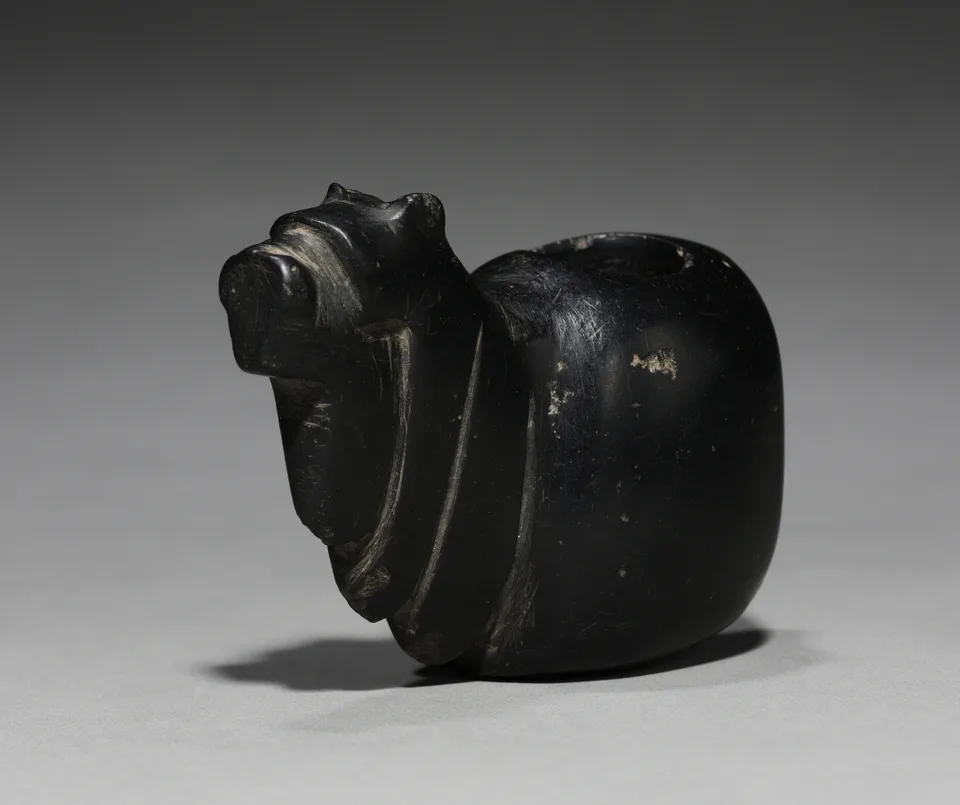
A small hollow in this animal’s back changes how we read it: a stone image was also a container for an offering.
The small animal keeps much of the compactness of the stone from which it was carved. Its neck and head project from a rounded body; long grooves separate the chest from the mass behind it. Instead of fragile, individually modeled legs, the underside forms a stable base. The shining dark surface makes the few carved edges especially clear.
The museum titles the object an alpaca offering container, or canopa, and assigns it to the Inka period. The opening on its back is crucial. An unidentified substance was placed there before the object was buried as an offering connected with the well-being and fertility of domestic animals. This purpose gives the cavity a significance beyond storage: filling and burial were parts of the object's use. We can identify the container and its broad ritual context without knowing exactly what it held. The missing contents are a limit on interpretation, not an invitation to supply a substance from imagination.
The contents are unknown. The museum title says alpaca while its short interpretive note says llama; this guide follows the catalogue title and avoids claiming that the carved features settle the species.