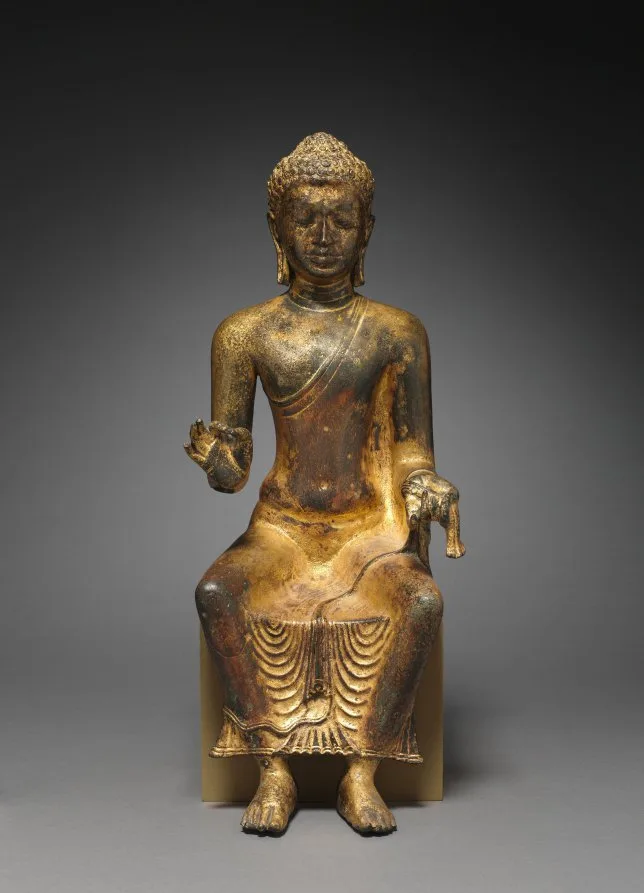
A teaching hand and carefully pleated robe preserve a seated Buddha’s presence even though the elaborate original throne is gone.
The robe changes character as it moves down the body. Near the chest it follows smooth contours; below the knees it gathers into sharply repeated folds. One hand is raised in a teaching gesture, while the other holds the garment’s edge. These contrasting details let the sculpture present both an idealised body and a carefully worked surface.
The museum places the image in Myanmar or Thailand and describes it as an early surviving example from mainland Southeast Asia. It once sat on an elaborate throne cast separately, which is no longer part of the displayed ensemble. The current support should therefore not be mistaken for the original setting. Compare the Standing Buddha from Myanmar: the figures differ in posture, material, and narrative possibilities, even though both invite attention to hands and robes. The missing throne also reminds us that a museum object may preserve its central figure while losing architectural or supporting parts that shaped the original encounter.
The museum gives Myanmar or Thailand as the origin, not one certain country. The separately cast original throne is absent, and the modern support does not reconstruct its appearance or full religious setting.