Read the
Picture
An open collection
Etruscan · Metalwork

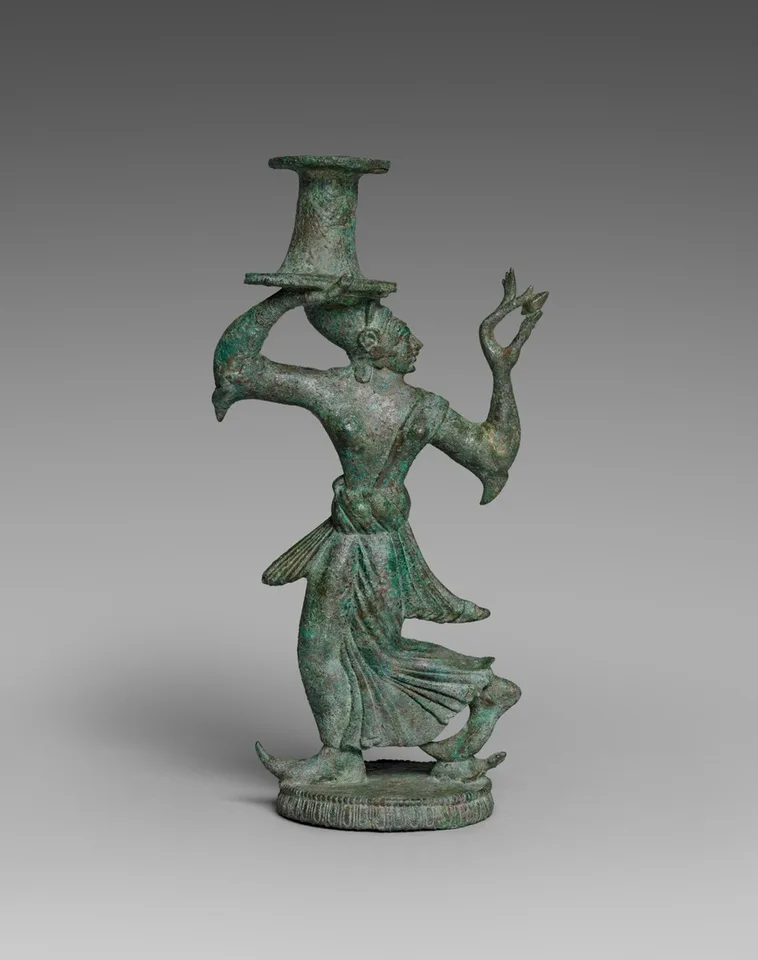
Candelabrum Stand of a Dancing Maenad

Maker unrecorded · 525–500 BCE

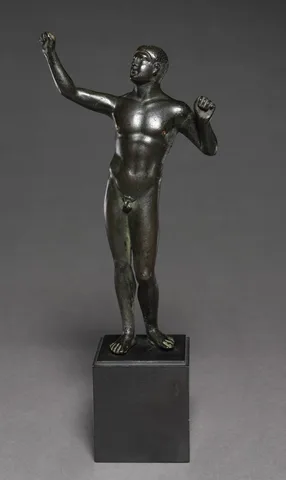
A small green bronze female figure steps sideways on a round base. One arm curves overhead beneath a tall cylindrical support, while the other is raised with long open fingers. A short object sits in the raised hand. The dress flares into pointed folds, and sharply pointed shoes extend in opposite directions.
100%

Drag to move · Pinch or +/− to zoom · Arrow keys to pan · 0 to reset

The Cleveland Museum of Art · 1953.124 · Image: CC0Museum image ↗
A little context

A dancer’s raised hand carries a cylindrical socket, so an animated silhouette also reveals its former job supporting a larger object.

The museum interprets this bronze dancer as a component of a candelabrum or incense burner. The cylindrical fitting above her raised hand makes that supporting role visible, even though the larger object is gone. Her pose is conceived mainly through a front-and-back silhouette, with limbs and drapery arranged to create an animated outline. The figure therefore combines a represented action with a practical task within a larger assembly.

The long fingers and pointed shoes are especially distinctive. They extend the body beyond natural proportions, while the dress opens into sharp, rhythmic folds. The museum associates these features with Etruscan workmanship and notes that the folds prioritize visual interest over a literal account of cloth. A small object in the free hand may be a fruit or clapper, but remains unidentified. That uncertainty need not prevent close looking: the hand’s shape, the flaring hem and the upper socket are all clear evidence of how movement and support were joined.

A careful reading

The larger candelabrum or incense burner is missing, and the held object may be a fruit or clapper. Neither the exact assembly nor that small attribute is securely reconstructed.
Try your eye

Which feature provides the strongest evidence that the dancer was part of a larger object?

Where this reading begins

  • Candelabrum Stand of a Dancing Maenad: collection record — The Cleveland Museum of Art. Identification, qualified cultural and maker attribution, materials, object-specific historical context, provenance and stated uncertainties; photograph independently inspected for visual observations. Museum record updated 2026-11-02; accessed 2026-11-14.

Our observations describe the supplied museum photograph. Historical identifications and context follow the cited collection record; interpretive limits are stated above. This is an independent guide, not a museum endorsement.

Image rights & attribution

Candelabrum Stand of a Dancing Maenad, 525–500 BCE. Etruscan. Bronze; overall: 18.8 cm (7 3/8 in.). The Cleveland Museum of Art, Purchase from the J. H. Wade Fund, 1953.124

Individual API record marked CC0; checked 2026-11-14. CC0 1.0 dedication. Record date: 2026-11-02 12:10:40.533000. Museum print JPEG preserved unchanged in local originals; overview JPEG resized and recompressed from that same full frame; responsive WebP and zoom derivatives resized and recompressed; numbered annotation overlay separate from image.