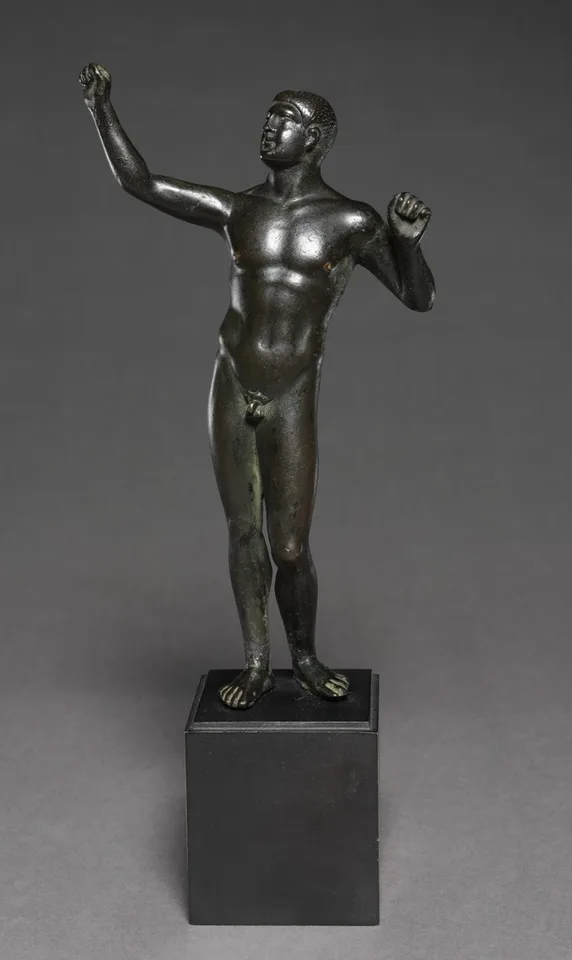
Raised hands look like an unfinished gesture until the missing leather thongs explain what this bronze athlete was doing.
The museum identifies this figure as a boxer tightening the leather thongs that Greek and Roman athletes wound around their hands. Those straps are now missing. Without them, the raised arms might be read as a greeting, dance or display, but the documented action offers a more specific explanation. The statue represents preparation rather than a punch landed on an opponent, focusing attention on a moment before combat.
The long body bends subtly between the two raised arms. One hand sits much higher than the other, drawing the head upward and creating an uneven triangle of limbs. The museum connects these elongated proportions and the sinuous curve with late Hellenistic sculptural practice. Look also at the feet, which remain near one another despite the upper body’s movement. The combination makes the figure feel balanced and active at once. Its current dark metal surface and modern base are the conditions of this photograph, not a complete reconstruction of its ancient display.
The hand straps are lost, so the specific action depends on the museum’s interpretation. The modern base and surviving surface do not recover the statue’s original setting or finish.