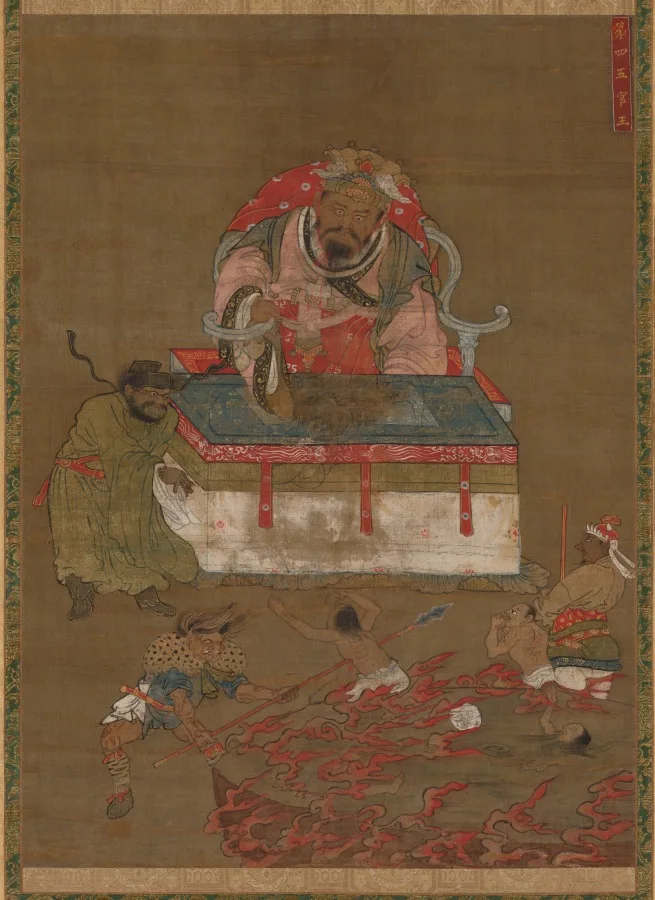
A judge above a scene of punishment turns the scroll into a moral narrative organised like a court proceeding.
The painting separates authority from its consequences. A richly dressed judge sits above a large table, accompanied by an assistant, while punishment unfolds below. The eye moves between the still, elevated court and the violent activity near the bottom. The museum identifies this as the Fourth King of Hell, originally one of a set of ten Buddhist judges of the dead.
The lower scene includes a cauldron and guards inflicting suffering. These are not presented as neutral observations of an earthly prison: the museum explains their role in promoting Buddhist ethical conduct and the importance of salvation in medieval East Asian traditions. It also notes possible inspiration from professional painting workshops in Ningbo, China. The work therefore belongs to a history of religious images moving between regions. Reading the table, assistant, and hierarchy first helps explain how the terrifying subject is structured, while avoiding the assumption that every Buddhist tradition describes the afterlife in exactly this way.
The lower scene depicts punishment and suffering. The painting represents a specific Buddhist moral and afterlife tradition; it is not a documentary image of an earthly court or a universal description shared by all Buddhists.