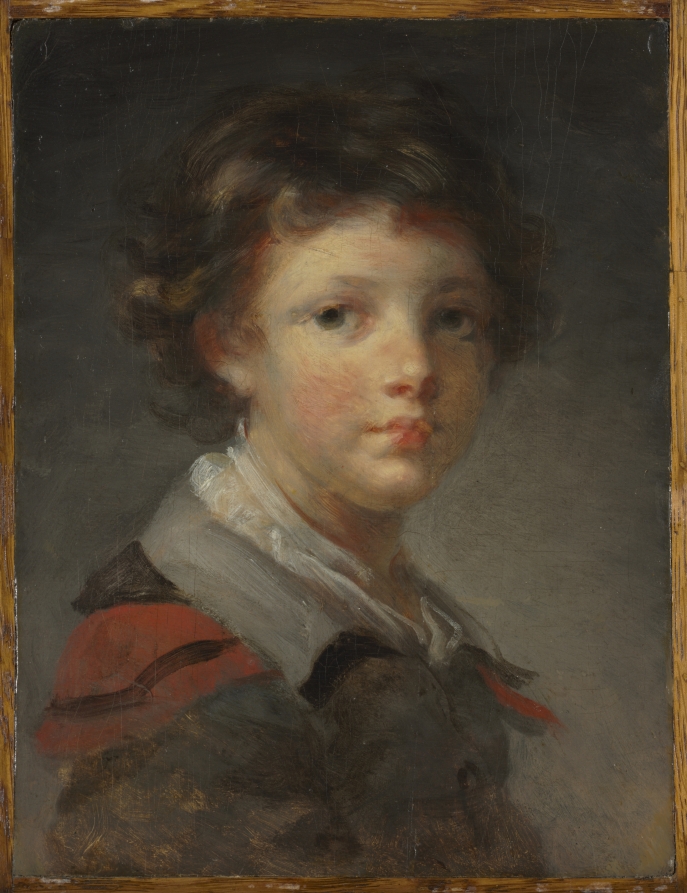
A child’s outward gaze feels personal, but costume and painterly references complicate a simple family-portrait reading.
The eyes hold the viewer while the body remains turned away. Fragonard surrounds the softly lit face with loose hair, a pale collar, and a dark garment interrupted by red lining. There is little setting to distract from the head. The close crop makes the encounter feel immediate, even though the costume introduces a deliberate distance from ordinary contemporary dress.
The museum notes the seventeenth-century clothing, brown palette, and handling as signs of Fragonard’s attention to Rubens and Rembrandt. These historical references are part of the portrait’s construction, not merely background knowledge about the painter. The sitter has often been proposed as the artist’s son, Alexandre Evariste, but that identification remains unconfirmed. Compare the carefully responsive face with the more loosely stated clothing: the image can suggest a familiar child while also exploring an older pictorial language. Its personal effect does not require us to turn a plausible name into a certain one.
The possible identification as Fragonard’s son is not confirmed. The historical costume is part of a pictorial presentation; it should not be treated as proof that the boy lived in the seventeenth century or regularly dressed this way.