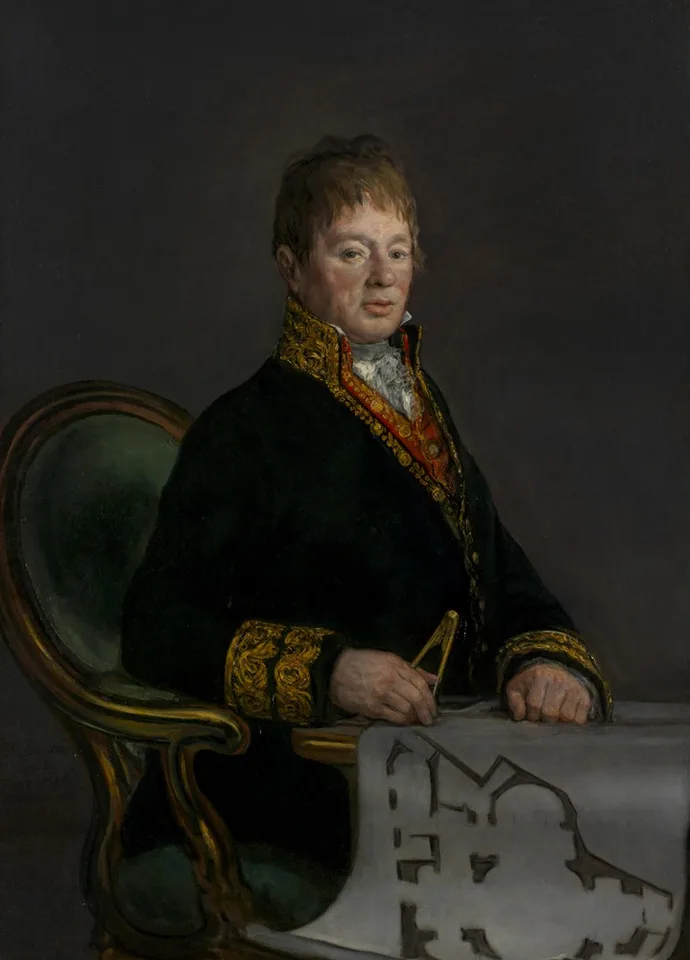
A plan and embroidered coat make professional authority visible before the sitter’s name is even read.
The sitter has the tools of a profession close at hand. One hand holds a drawing instrument, and a large architectural plan unfolds toward the viewer. Gold and red ornament at the collar and cuffs contrasts with the otherwise dark coat. Goya uses a restrained setting to make these particular objects and surfaces carry much of the portrait’s information.
The museum identifies Don Juan Antonio Cuervo as director of the Royal Academy of San Fernando, Spain’s official academy for artists and architects. The plan represents his renovation of Madrid’s Church of Santiago, while the decorated jacket marks academy membership. These are unusually specific links between visible objects and documented work. Goya’s friendship with Cuervo adds context, but professional presentation remains central. Compare the face, the working hand, and the plan: the picture constructs an image of intellectual authority through a person, an instrument, and an accomplished project while the inscription at the lower left explicitly names Cuervo and Goya.
The building and academy associations come from the museum’s identification. The visible floor plan cannot independently establish every detail of Cuervo’s renovation, and a professional portrait should not be treated as a complete assessment of his career.