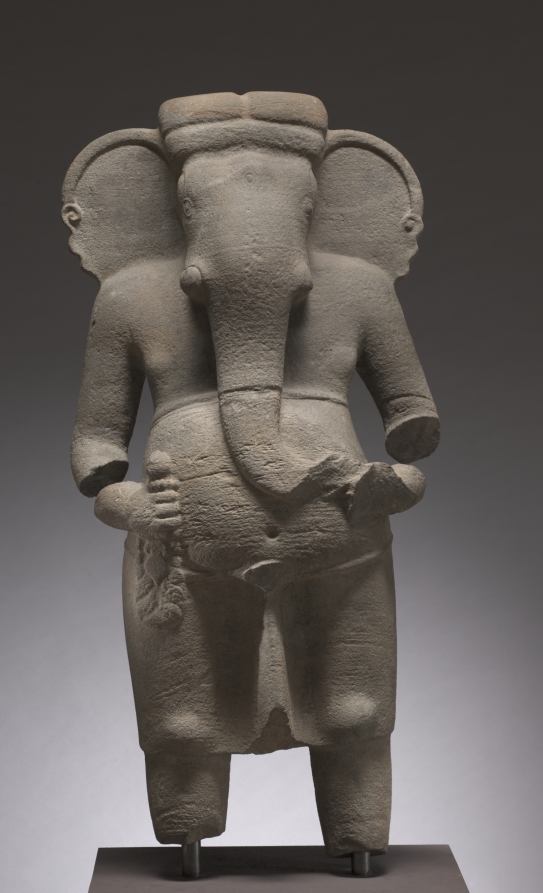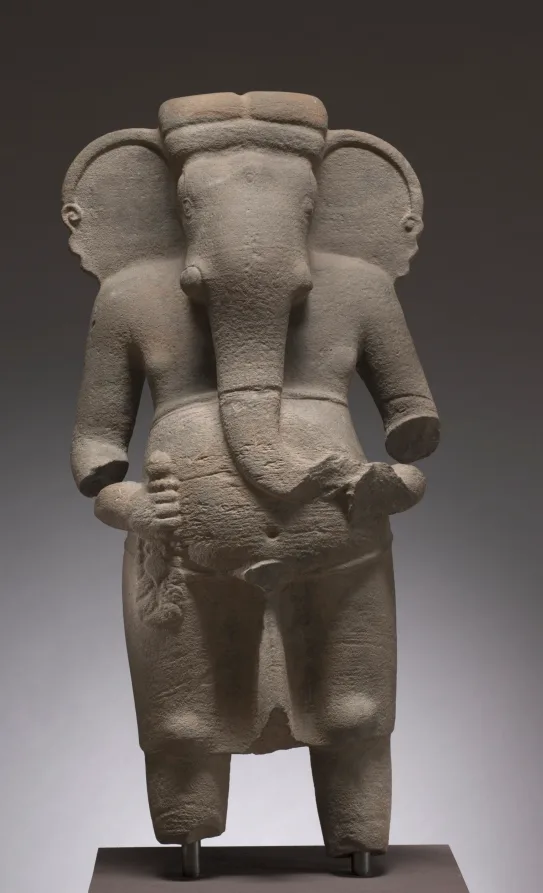
An elephant head is the first clue; the clothing and surviving hands make this early Southeast Asian Ganesha more specific.
An elephant’s head on a humanlike body makes Ganesha immediately distinctive, but the rest of the sculpture deserves equal attention. The rounded belly, short wrapped garment, and broad ears create an unusually compact silhouette. Made in the seventh century in the region of southern Cambodia or Vietnam, this work belongs to an early history of large stone images of Hindu deities in Southeast Asia.
Ganesha is associated with obstacles: he can place them in a person’s path or help remove them. The museum describes prayers and food offerings made to him at the start of an undertaking, and identifies sweet cakes and a radish in this sculpture. The worn stone and breaks around the arms make the small surviving forms harder to distinguish than the broad head and trunk. The catalogue helps connect those fragments with Ganesha's enjoyment of food, while the short belted garment gives the image a distinctly Southeast Asian form.
The find region is recorded as southern Cambodia or Vietnam, not one certain modern country. Damage limits what the photograph alone reveals about the hands and their originally held objects.