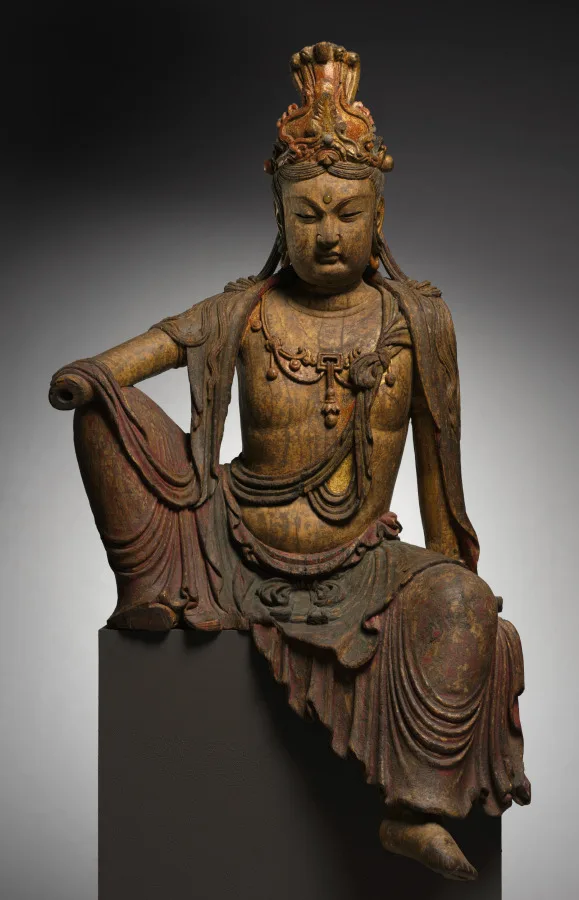
A relaxed knee, a level gaze, and traces of colour give this wooden image of compassion a remarkably bodily presence.
This figure’s posture is the first invitation to pause. One knee rises, an arm rests across it, and the opposite leg drops downward. The museum identifies the sculpture as South Sea Guanyin, the compassionate bodhisattva associated with the mythical island of Potala. A rocky throne originally made that setting more explicit; the present museum support should not be mistaken for the whole original composition.
The figure is carved from wood, with surviving colour and gilding. That matters: the worn brown surface we see today is not a reliable guide to how richly coloured it once appeared. The museum records conservation work that removed later varnish and paint to reveal earlier decoration. Look at the jewellery, drapery, and face as parts of a once-coloured body rather than as a modern monochrome carving. The relaxed pose and downward gaze allow a reading of calm attention, while the identification as a compassionate guide comes from the work’s Buddhist context.
Missing hands, the absent rocky throne, and layers of restoration affect the sculpture’s appearance. The museum’s identification supplies religious context that cannot be recovered simply by reading a facial expression.