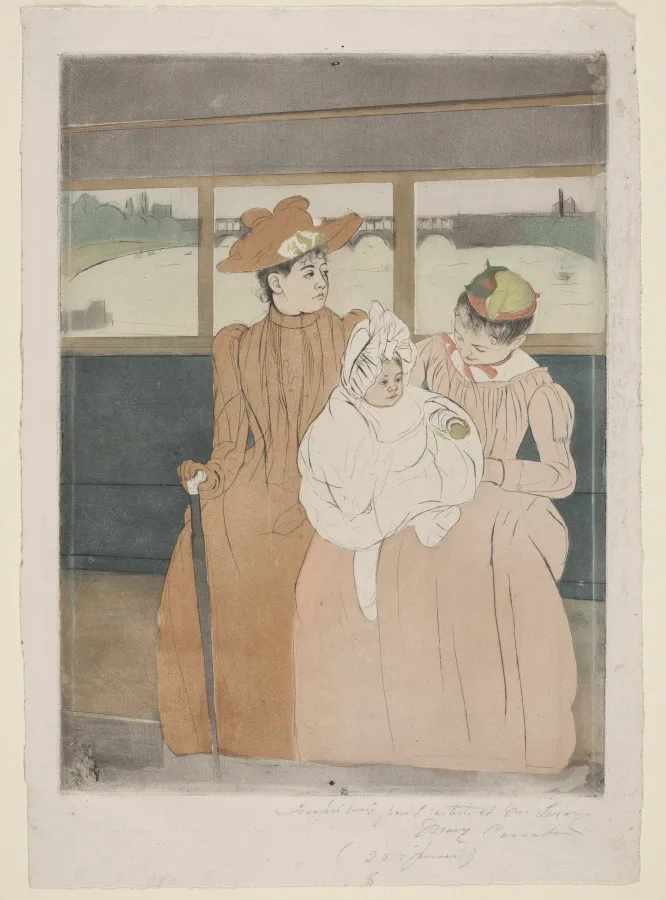
Two directions of attention tell different stories inside a shared carriage: one woman looks outward, the other toward the child.
Three passengers occupy the same small space, but their attention is not identical. One woman turns her face outward while the other bends toward the child on her lap. The museum identifies them as a middle-class woman, her nursemaid, and her child, traveling through Paris in an omnibus. This form of public transport brought people of different classes and genders into proximity, making an ordinary journey a useful setting for observing social relationships.
Cassatt made the print as part of a series shaped by her study of Japanese woodblock prints. The influence here concerns choices such as flat areas of color and everyday subjects, not an equivalence between French and Japanese social life. Look at the large, softly colored dresses and the strong window divisions behind them. Fine outlines carry much of the information while the broad color areas keep the design clear. The result combines an intimate act of care with a view into the public world beyond the carriage.
The passengers’ roles come from the museum’s identification, rather than clothing alone. Their different gazes are visible, but distraction, tenderness, or other emotional states remain interpretations of those gestures.