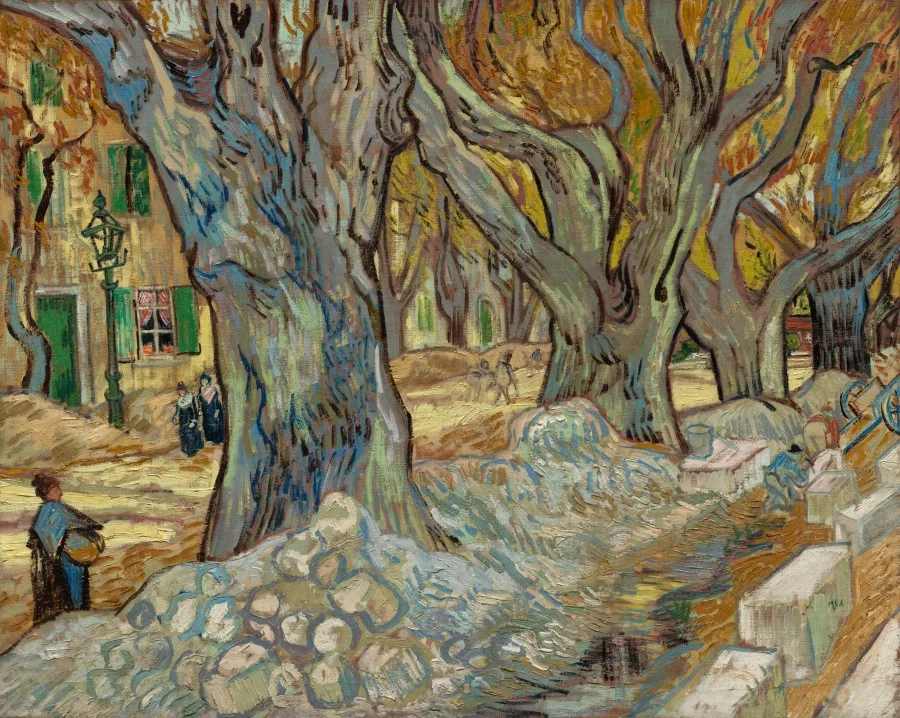
The trees dominate, but the heaps of stone and small workers reveal an ordinary street in the middle of repair.
The enormous trunks are easy to notice; the roadworks take a little longer. Piles of stone lie across the foreground, and small figures appear between the trees and buildings. Van Gogh painted this view at Saint-Rémy in 1889 while living at a nearby psychiatric hospital. The museum notes that he was permitted to work outside and described this particular street-repair scene in a letter to his brother Theo.
The picture’s energy does not require us to diagnose its maker. Look instead at concrete decisions: dark outlines curl around the trunks, blue strokes interrupt brown bark, and the stones form a pale moving band across the bottom. The small figures give scale to trees that might otherwise feel almost abstract. Building fronts remain visible through gaps, so the scene continually shifts between village activity and a patterned surface. A later version of this composition exists elsewhere; the museum’s conservation research identifies this Cleveland painting as the earlier one.
Avoid treating every forceful brushstroke as a symptom of the artist’s illness. The museum documents his circumstances, but the visible choices of color, line, and scale can be examined without speculative diagnosis.
Which detail confirms that this is a street-repair scene as well as a view of trees?
Practise looking at The Large Plane Trees (Road Menders at Saint-Rémy) →