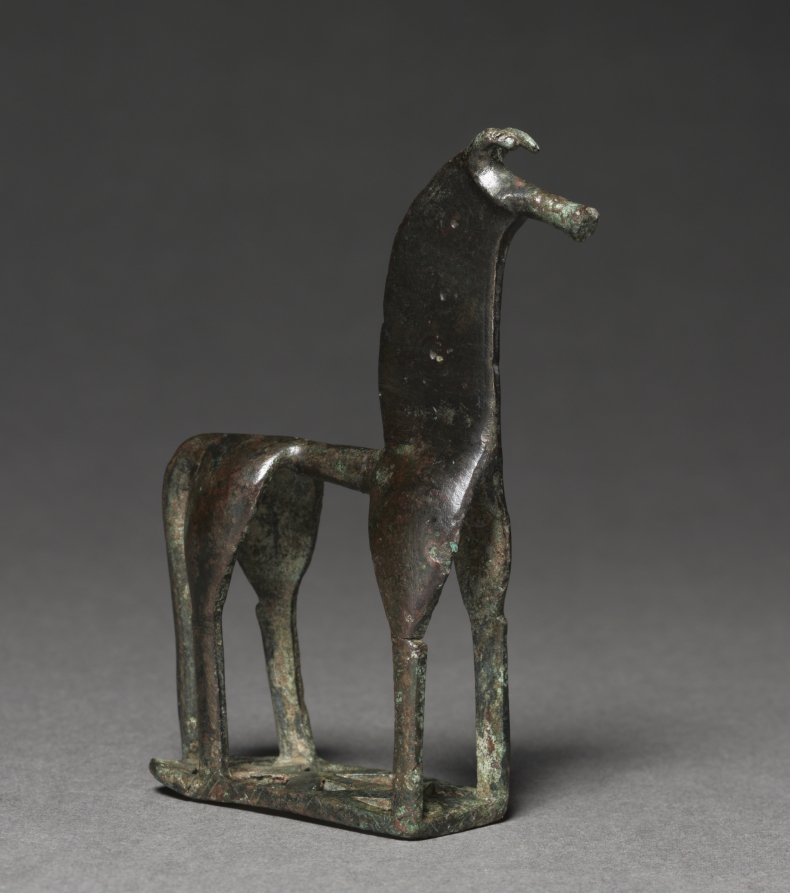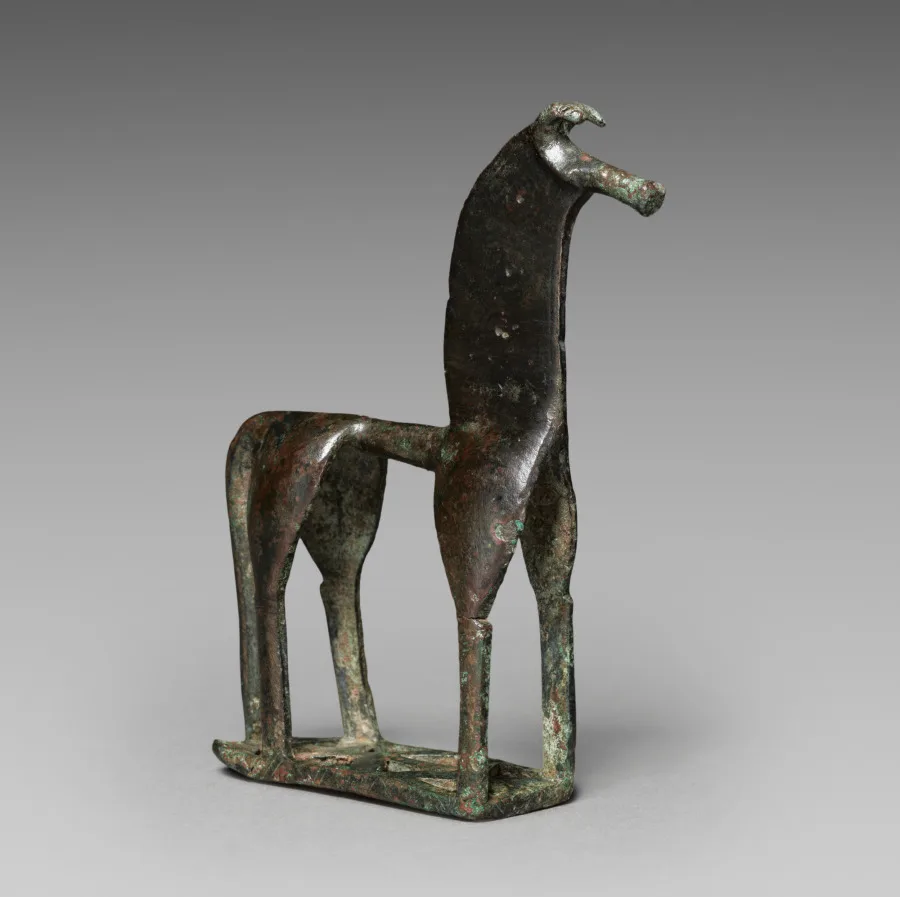
A tall neck, small head and thin legs make a horse immediately legible through a few carefully balanced bronze forms.
The horse is easy to recognize without naturalistic proportions. A high neck, small muzzle, tail and long legs supply a few decisive cues, while large open spaces separate them. The figure's clarity depends on the balance of solids and gaps. Looking at its outline is more useful than judging it against a photograph of a living horse.
The museum dates the bronze to the Greek Geometric period and describes lost-wax casting. It suggests a Corinthian workshop from the form, but the findspot is unknown. That distinction matters: stylistic attribution is not the same evidence as a documented excavation. The perforated base also becomes part of the design, allowing light through a surface that might otherwise seem heavy. The museum tentatively relates this effect to water, but the visible openings do not settle that interpretation. The work rewards attention to formal economy while retaining gaps in its ancient context.
The Corinthian attribution is stylistic and the findspot is unknown. The possible water association of the base is speculative; perforations can be described confidently without assigning them a certain symbolic meaning.