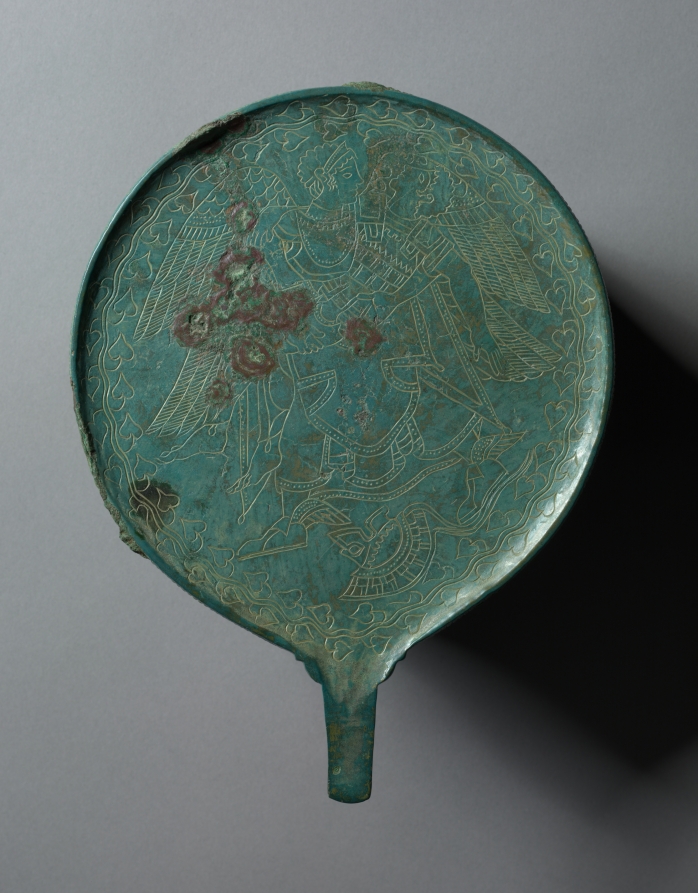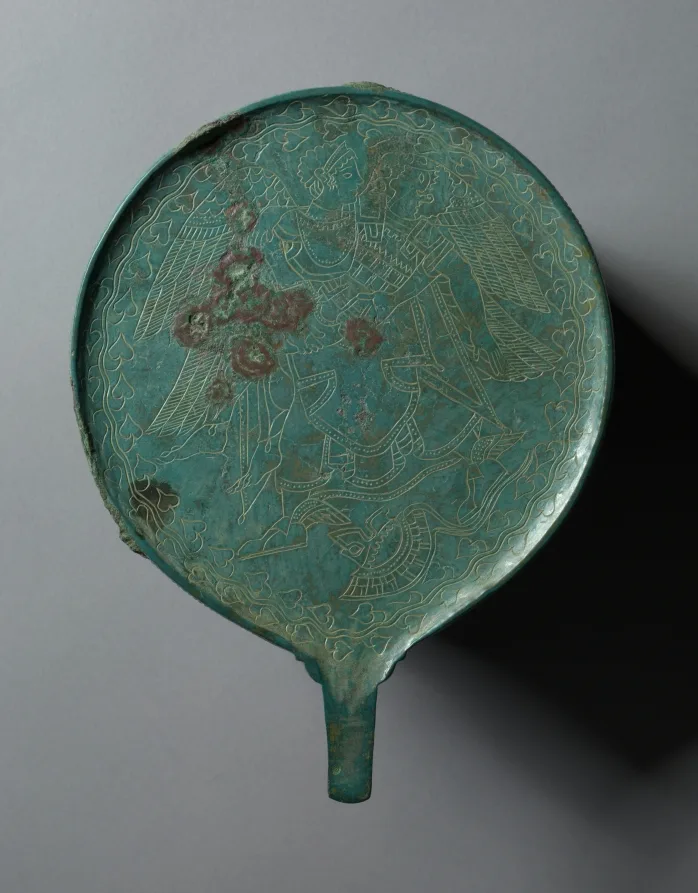
A winged mother carries an armored body across the back of a mirror, with a fallen helmet completing the story's loss.
The fine lines are easier to follow one object at a time. Start with a broad wing, move toward the overlapping bodies, then find the helmet below. The circular border gathers a complex narrative into the reverse of a useful object. This is the decorated back of a mirror, not its reflecting side.
The museum identifies the Etruscan dawn goddess Thesan carrying her dead son Memnun, known in Greek tradition as Eos and Memnon. His armor and fallen helmet locate the scene in the aftermath of battle at Troy. The mother's wings and winged footwear distinguish her from an ordinary mourner. A short tang below the disk once entered a larger handle, probably bone or ivory. The absent grip and changed metal surface remind us that the engraved image survives within an incomplete object. Narrative identification helps disentangle the figures, while construction details recover something of its everyday handling.
The larger handle is missing and its proposed bone or ivory material is uncertain. Fine engraving is affected by wear and patina, so the museum's identification is needed alongside the visible outlines.
Which part of the mirror are we looking at?
Practise looking at Mirror with Engraved Scene: Thesan and Memnun (Eos and Memnon) →