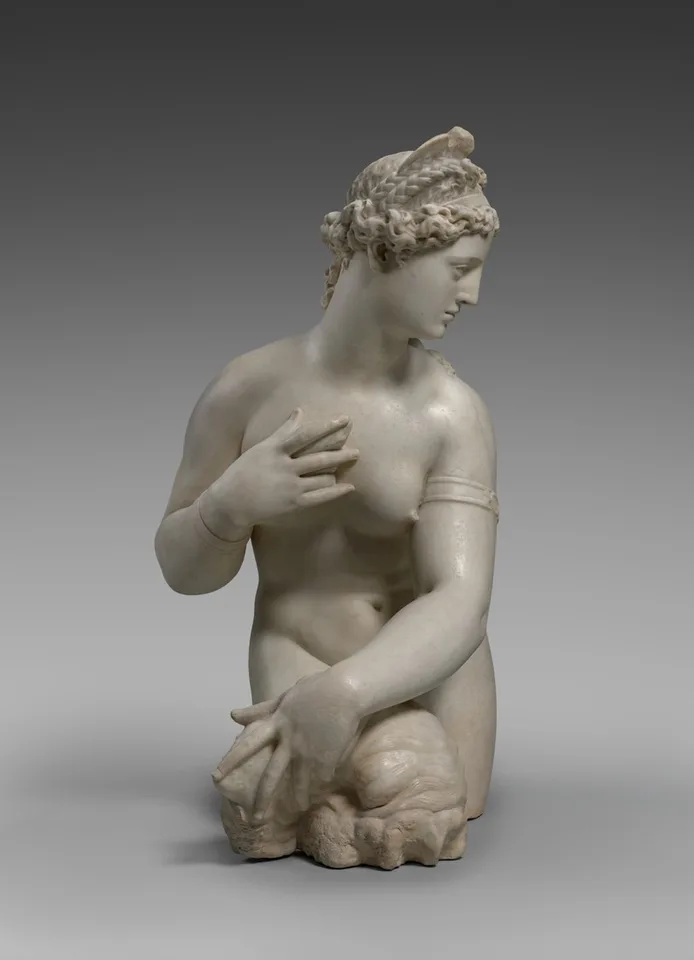
A turn of the head continues through the torso and hands, inviting movement around a figure originally made for a fountain.
The seated body does not settle into a frontal pose. The head turns right, the shoulders rotate, and the lower hand reaches across a rough support in another direction. Smooth marble flesh is framed by tightly worked hair above and textured stone below. Those differences make the figure feel responsive despite the hardness of its material.
Giambologna made Fata Morgana for banker Bernardo Vecchietti’s fountain at Villa Il Riposo near Florence. The name linked the nearby spring with the legendary fairy who restored King Arthur’s youth, a playful association with a patron whose surname meant “old.” The museum emphasizes the twisting pose’s invitation to viewing from several angles. The sculpture later left its original setting; the record documents export permission in 1775 and Cleveland’s acquisition in 2025. The present photograph allows close study but cannot recreate the fountain’s water, architecture, or changing viewpoints.
The sculpture’s original fountain setting is absent, and this photograph supplies only one viewpoint. The fairy association belongs to a specific commission, not a general meaning for every female nude.