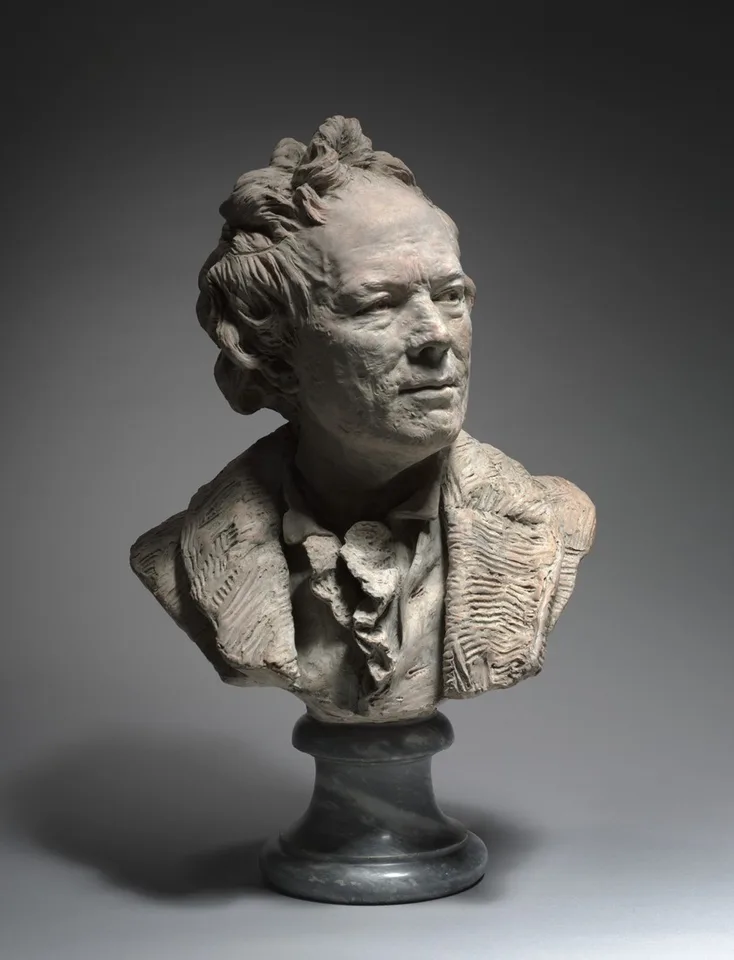
An unpolished face looks truthful, yet the open collar and untidy hair also follow a convention for depicting artistic genius.
The face has small irregularities that prevent it from becoming an idealized mask. Furrows cross the brow, and the cheeks retain uneven marks. Around it, the hair rises in loose swept strands, while the open collar creates an informal frame. The incised coat surfaces remain visibly worked, so material touch and represented texture overlap.
Houdon portrays the composer Christoph Willibald Gluck, associated with reforms that brought greater simplicity to opera. The museum explains that the pockmarked face was understood as natural and truthful, but it also cautions that Gluck would not have appeared publicly in this state of undress. Untidy hair and an open collar were established ways of presenting an artist. The portrait thus combines observed particularity with a chosen social role. Recognizing that combination makes the bust more interesting than a simple opposition between honest realism and artificial idealization.
The informal clothes are a portrait convention, not proof of how Gluck usually appeared in public. The bust’s pockmarks do not authorize broader assumptions about his health or character.