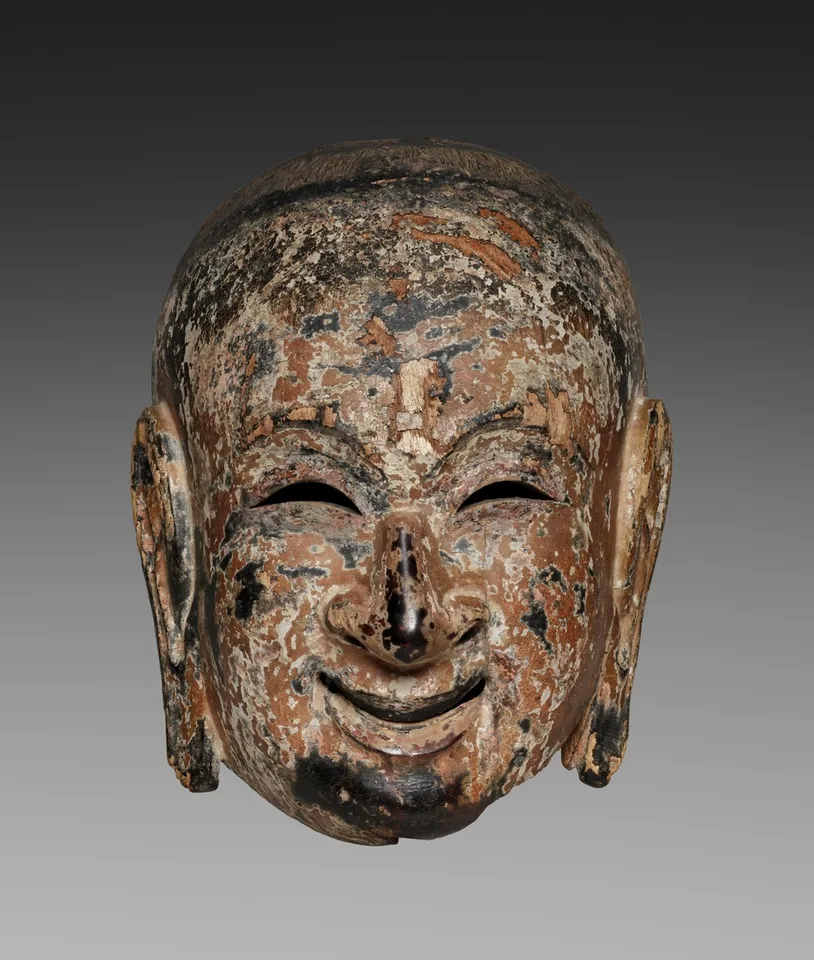
A smiling wooden face has openings for a living performer, reminding us that this apparent portrait was made to move.
The smile appears fixed, but the openings remind us that a living actor once supplied movement behind it. Narrow eye slits, nostrils and a mouth opening allowed the mask to be worn. Long ears and emphatic brows make the expression readable at a distance, while the surviving paint now breaks the face into mottled patches.
The museum identifies the role as one of the sons of an elderly Persian widower in gigaku, a theatrical dance repertoire introduced to Japan from continental Asia in the seventh century. The father and sons mime prayers to the Buddha. This is therefore a stage identity within a transmitted performance tradition, not a reliable portrait of a Persian child. The mask would cover the actor’s whole head, a scale of use that the frontal photograph only partly conveys. Its worn surface records survival rather than its complete original stage appearance.
The mask represents a theatrical role, not a documentary image of Persian ethnicity. Its damaged painted surface and static display differ from its appearance in performance.
What makes the face recognisable as a usable mask rather than a solid head?
Practise looking at Gigaku Mask of Young Persian Boy (Taikōji) →