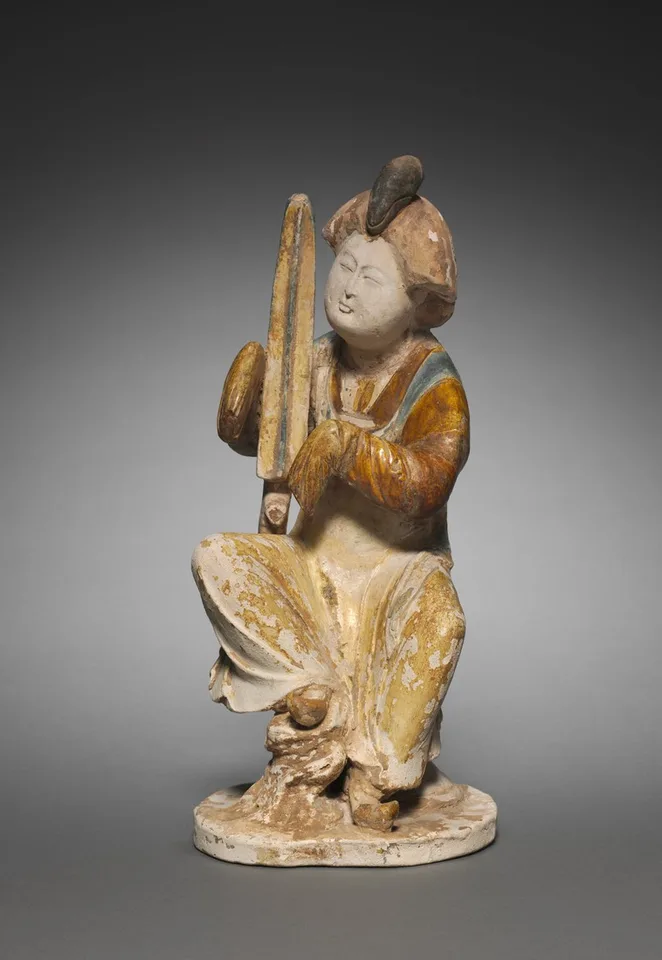
A small musician’s tilted head and raised instrument preserve the shape of a performance, though none of its sound survives.
The instrument stands almost as high as the musician’s head. Her hands approach it from either side, while the raised knee supports its lower end. The face, with rounded cheeks and a slight turn, gives the pose a sense of attention. Her long robe falls around the seated body, and traces of colour distinguish fabric, hair and skin.
The museum identifies an angular harp of a type prominent in Tang court orchestras by the mid-eighth century. It places this figure among tomb sculptures that evoke contemporary fashions and activities. The musician therefore represents a desired world of cultivated life within a funerary setting, rather than documenting one recoverable concert. Her hairstyle and clothing offer another route into the object: they show how performance could be made visually elegant even when the instrument’s strings and sound cannot be restored from this photograph.
This funerary image is not a portrait of an identified musician or a record of a particular performance. The photograph cannot reconstruct the harp’s sound or playing technique.