Read the
Picture
An open collection
A guided journey · 5 works

Performance and attentive bodies

Bodies can suggest sound, play, labour or a role, but each suggestion needs a different kind of context. Follow hands, supporting knees, openings and costumes. These images make activity legible while leaving the original performance or lived event beyond recovery.

Begin the journey ↓
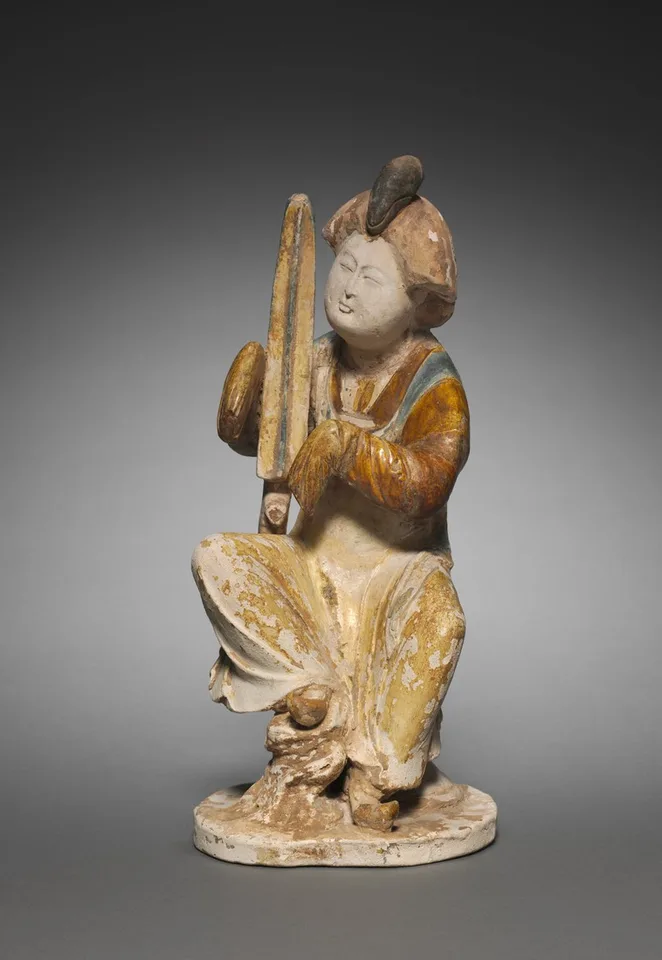
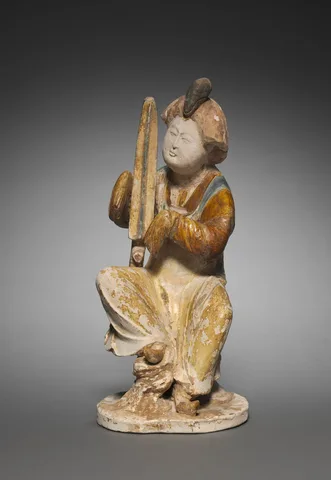
A seated ceramic woman holds a tall angular instrument against her body. Her pale face tilts slightly upward beneath a high coiled hairstyle. Ochre, green and pale colour remains on her long robe, which falls over bent legs and pointed shoes above a circular base.
01A seated ceramic woman holds a tall angular instrument against her body. Her pale face tilts slightly upward beneath a high coiled hairstyle. Ochre, green and pale colour remains on her long robe, which falls over bent legs and pointed shoes above a circular base.
Harpist · mid-700s

Support the instrument

The raised knee holds the harp while the hands approach it. This relationship gives the funerary musician a convincing task, even though the sculpture cannot preserve the original music or identify a performer.

Carry this question: How much of the activity can be understood without hearing it?

Open the artwork ↗
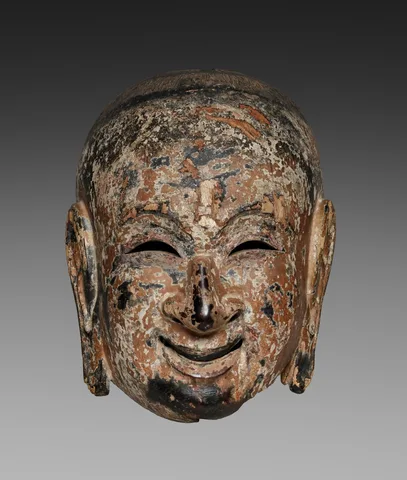
02A worn wooden mask has a rounded face, high arched eyebrows and narrow open eyes. A projecting nose sits above a broad smiling mouth, and long ears extend at either side. Red, cream and dark patches remain across the surface, revealing the uneven survival of its painted finish.
Gigaku Mask of Young Persian Boy (Taikōji) · 710–94

Put a person behind the face

Eye openings make the fixed expression usable by a performer. The Persian-boy identity belongs to a gigaku role, so the mask should be studied as theatre rather than as an ethnic portrait.

Carry this question: What changes when you imagine movement behind the eye openings?

Open the artwork ↗
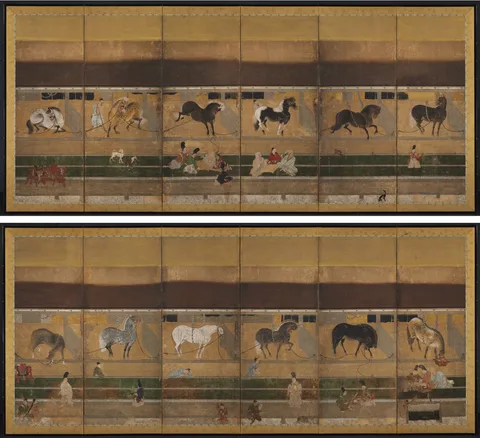
03A pair of long folding screens appears one above the other. Rows of differently coloured horses occupy individual stalls beneath broad roofs. Small figures sit or stand on the verandas in front, with birds, attendants and groups gathered around boardgames. Gold and brown architectural bands unify the repeated compartments.
Horse Stable · early 1500s

Look below the main subject

The veranda’s game players expand a scene apparently devoted to horses. Moving between stalls and people reveals a social setting of prized animals, strategy and leisure across the paired screens.

Carry this question: Which activity did you overlook when you first noticed the horses?

Open the artwork ↗
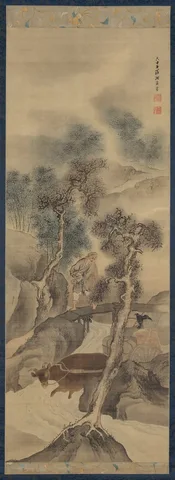
04A narrow ink-and-colour landscape shows a farmer on a small bridge beside a water buffalo pulling a loaded cart through a stream. Tall trees with twisting trunks frame the crossing. Rocks, pale water and misty distant slopes occupy the vertical space, with writing near the upper right.
Farmer Returning Home in Autumn · 1781

Divide the crossing

The buffalo takes the water with the cart while the farmer remains on the bridge. The different routes create a small comic incident within a carefully composed autumn landscape.

Carry this question: Who carries the practical burden of the crossing?

Open the artwork ↗
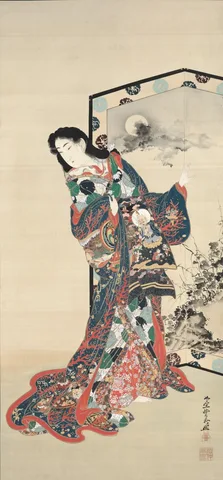
05A richly dressed woman stands before a folding screen in a tall painting. Her elaborate dark outer robe is filled with small coloured figures and patterns, with red-edged fabric trailing across the floor. Her pale face turns sideways; behind her, the screen shows a moonlit ink landscape.
Hell Courtesan · 1871–89

Read costume as another stage

Small figures on the robe transform decoration into religious parody. The legendary biography and Kyōsai’s later reinterpretation remain distinct, even though both shape how the costume is read.

Carry this question: When does ornament become a narrative inside the larger image?

Open the artwork ↗
Take this with you

Use posture and equipment to identify represented activity, then keep reconstruction of the lost event modest.

Try an exercise with the first work →

Find another journey →

Read with the sources

Historical context follows the individual museum records linked on each artwork page. These routes make original comparisons of visible form; resemblance alone is not evidence of shared meaning or direct influence.