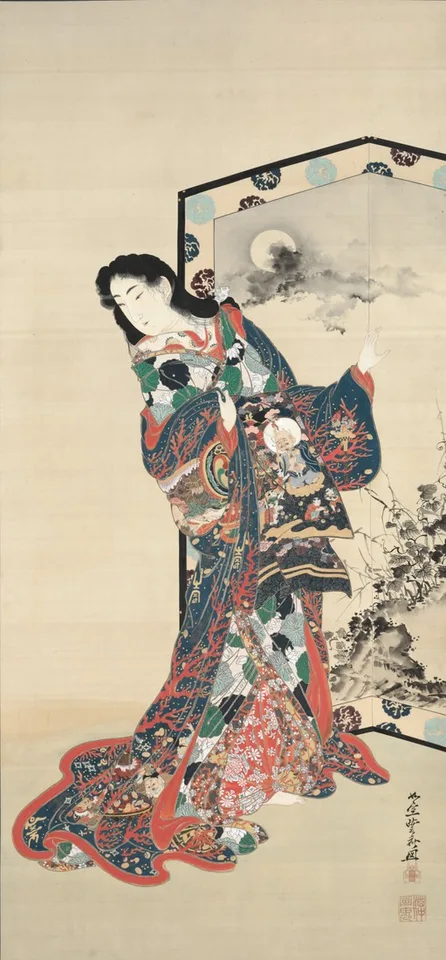
The woman’s spectacular robe contains another drama, turning costume into a crowded stage for fortune, judgement and religious parody.
The woman’s pale face offers a quiet entry into a much busier image. Follow the robe downward and its decoration becomes a collection of small figures, not merely repeated flowers or geometric patterns. Red borders guide the eye around the heavy fabric as it pools near her feet. The folding screen behind her provides another picture within the picture.
Kyōsai painted several variations on the Hell Courtesan, a legendary fifteenth-century woman said to wear images of Buddhist hells as a response to suffering. In this version, the museum identifies a parody: she stands in for Benzaiten, while other members of the Seven Gods of Good Fortune appear on her robe alongside judgement imagery involving Enma. The historical legend, the artist’s later reinterpretation and the visible costume should remain distinct. Her appearance cannot establish the truth of the story told about her life.
The courtesan’s biography belongs to legend, and this painting reworks it through parody. The garment’s small figures should not be treated as a simple literal illustration of her life.