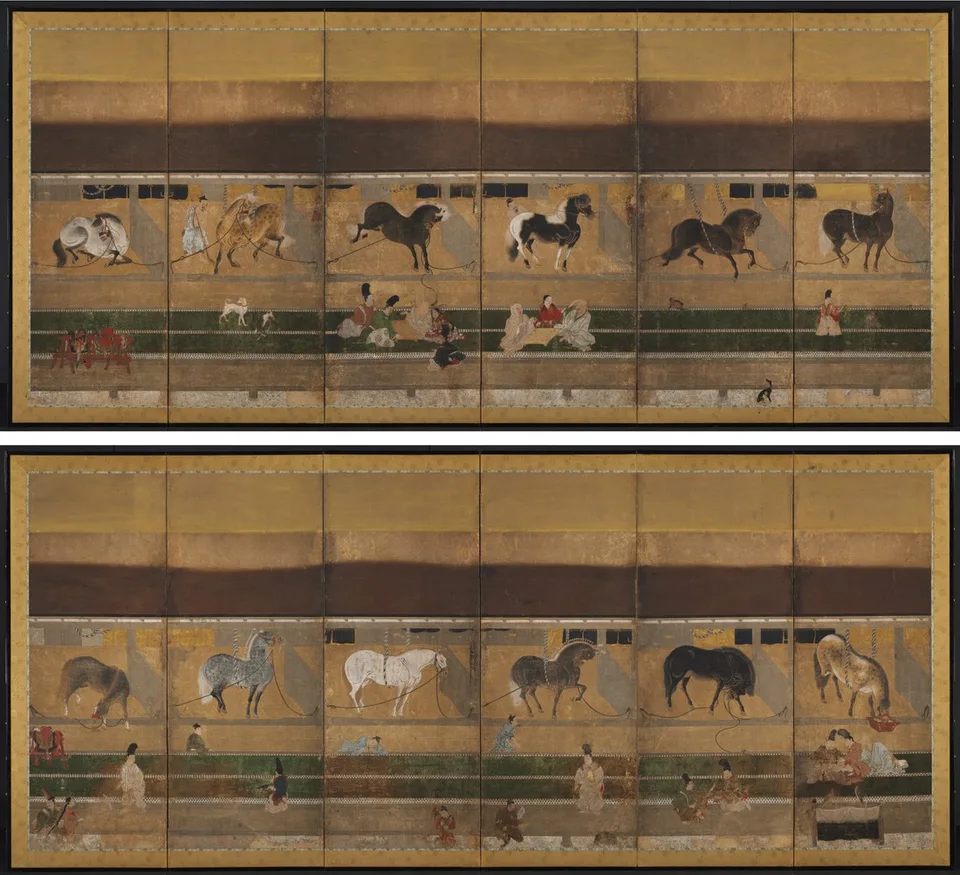
The horses command the stalls, but the people on the verandas reveal another set of contests and cultivated activities.
The repeated stalls establish a steady rhythm, but the horses refuse to be identical. Different colours, poses and turns of the head give each compartment its own incident. Below them, the veranda contains a second, smaller scale of activity. People gather around games or attend to birds, creating a lively social world beneath the prominent animals.
The museum identifies falconry on one screen and the boardgames go and shōgi on the other. The paired work is described as the earliest surviving example of the horse-stable theme in Japanese screens. That context helps us understand why the subject extends beyond animal portraiture: prized horses, birds of prey and strategic games all contribute to a setting of cultivated leisure. The architecture holds them in parallel bands. We can compare those activities without assuming that every figure belongs to a known household or that all the events were observed together.
The screens depict a composed social setting rather than an identified stable inventory. Individual horses, players and attendants are not securely named in the museum record.