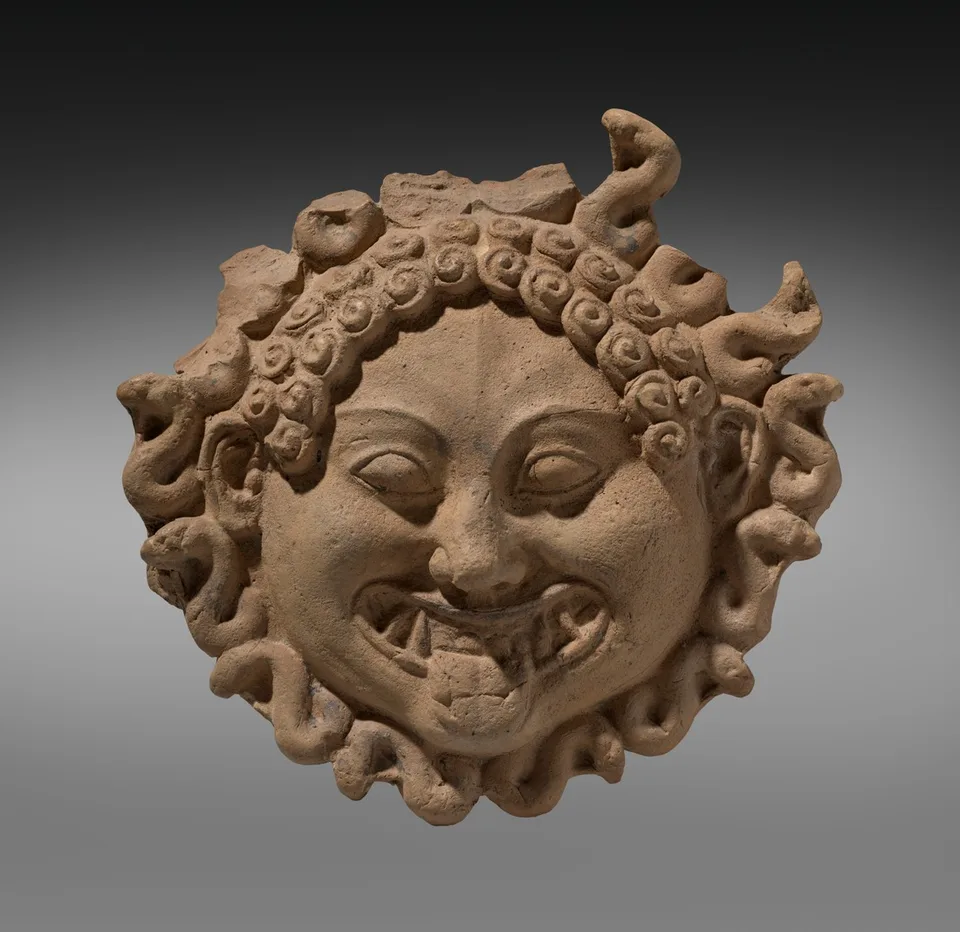
An enormous tongue and curling snakes turn a roof ornament into a face that refuses to remain a quiet architectural detail.
This mold-made terracotta was an antefix, an ornamental element attached to a roof. It takes the form of a gorgoneion, the head of a Gorgon presented without a body. The museum associates its staring eyes, exposed tongue, sharp teeth and surrounding snakes with an appearance that may have been both frightening and protective. The face therefore belonged to architecture, where it would have met viewers at a very different height and distance from this close photograph.
The mouth carries the most concentrated disruption of ordinary facial proportions. Its tongue drops below the teeth, while tusks interrupt the grin. Around it, the snakes form an unstable outer boundary that contrasts with the nearly circular face. Small traces of pigment suggest the clay once appeared more vividly coloured. The broken tips and worn surface now soften parts of that effect. It is useful to distinguish the visible exaggeration from the proposed protective purpose: the first can be inspected, while the second depends on ancient architectural and religious context.
The original roof and full colour scheme are not preserved here. A protective effect is a contextual interpretation, and present breakage changes the outer ring of snakes.
Which feature extends the face’s outline into curling projections?
Practise looking at Gorgoneion Antefix (Ornamental Roof Tile) →