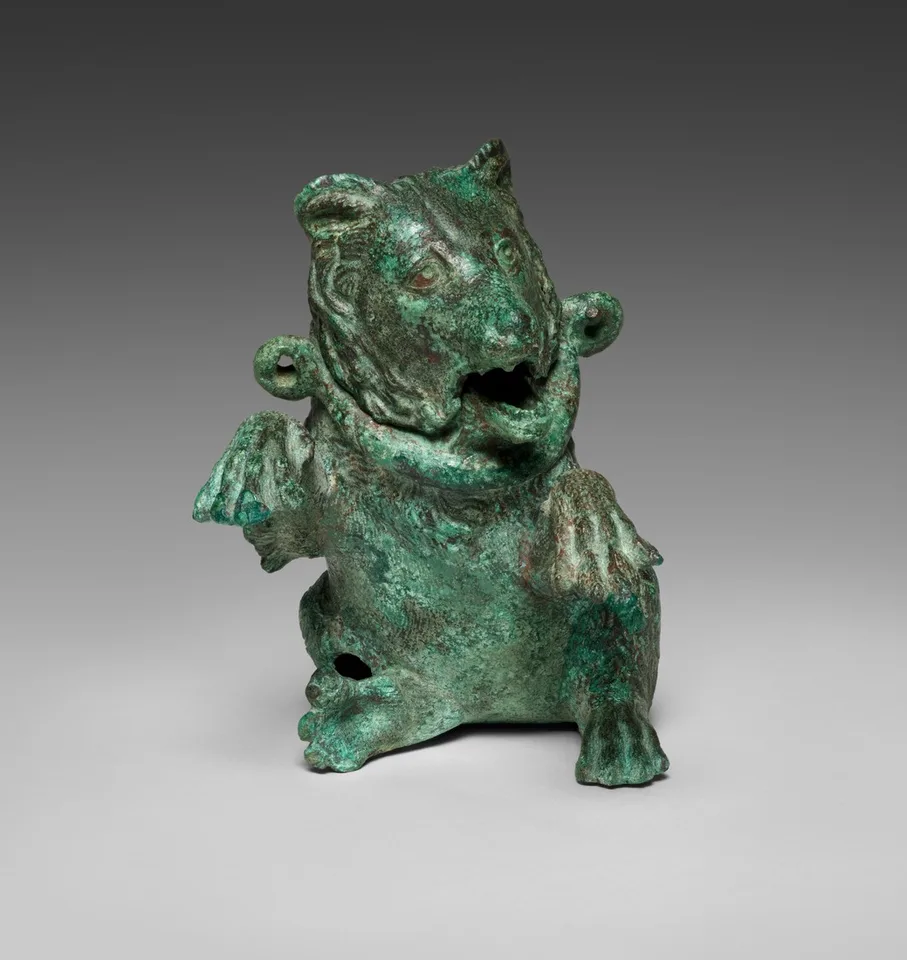
A bear’s open mouth doubles as a spout, while rings beside its collar reveal that this lively little animal could hang from a chain.
This Roman bronze bear is an ampulla, a small container for oil or another liquid. The museum describes a hinged head that opened at the back of the collar, a lower jaw that formed the spout and pierced eyes that prevented an airlock. Rings beside the neck held a suspension chain. Features that first appear to belong only to an animal image also served the practical needs of filling, carrying and pouring.
The raised paws and upright seat give the bear its “dancing” pose. The museum connects this with the use of animals as entertainment in antiquity, a human setting rather than a scene of wild behaviour. The open mouth becomes particularly important when we know it was a pouring point. The rings at the collar are equally revealing, turning an apparent costume detail into a carrying mechanism. The chain is absent and the metal is worn, so the photograph preserves the design more fully than the container’s former working condition.
The chain is missing and corrosion obscures details of the mechanism. The dancing pose refers to human entertainment practices; it should not be read as evidence of a naturally cheerful animal.
Which visible feature allowed the vessel to hang from a chain?
Practise looking at Oil Ampulla in the Form of a Dancing Bear →