Read the
Picture
An open collection
Italy, Vicarello (ancient Aquae Apollinares), Roman, Augustan period · Metalwork

The Vicarello Goblet

Maker unrecorded · 25 BCE–25 CE

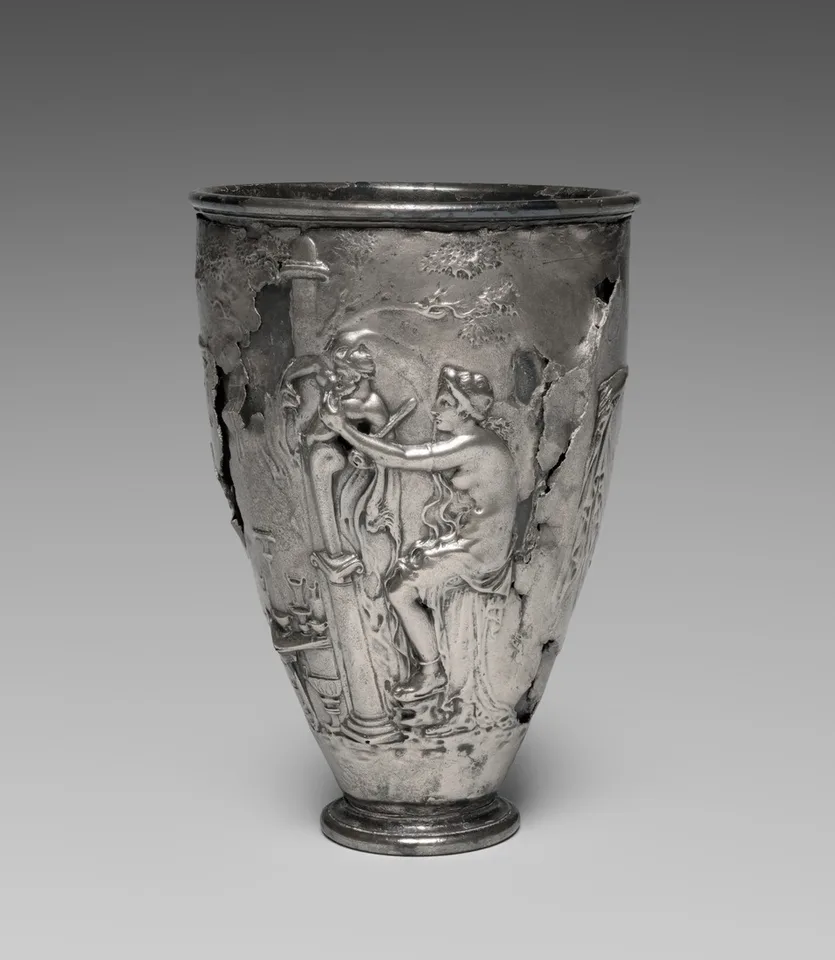
A tall silver goblet narrows toward a small round foot. Figures and architectural details rise in relief from its curved wall. A woman at the front reaches toward a small figure above a column, with drapery gathered around her lower body. Dark cracks and losses interrupt the reflective metal surface near the rim and sides.
100%

Drag to move · Pinch or +/− to zoom · Arrow keys to pan · 0 to reset

The Cleveland Museum of Art · 1966.371 · Image: CC0Museum image ↗
A little context

A reaching hand connects a woman to a tiny shrine figure, while the curved silver wall makes the surrounding scene disappear around its sides.

The museum identifies the scene on this Roman silver goblet as a rustic shrine of Priapus, a fertility deity associated with Dionysos. The god appears as a stylized boundary marker on a column. A woman reaches toward him and seems to animate him through touch. Elsewhere around the vessel are offerings and dancing followers of Dionysos. The curved surface prevents a single photograph from displaying the entire arrangement at once.

The reaching arm supplies a particularly clear visual connection: it bridges the space between the woman and elevated shrine figure. Beneath it, folded drapery and a long column create different kinds of vertical line. The silver carries both delicate modeled forms and conspicuous cracks or losses, so the present reflective surface is far from seamless. Turning the goblet would unfold the scene gradually. In this view, the central encounter is the strongest evidence, while descriptions of figures around the sides necessarily depend more heavily on the museum record.

A careful reading

This photograph does not show the whole relief around the goblet. The woman’s apparent animation of the god is the museum’s interpretive reading, and damaged areas interrupt the scene.
Try your eye

What visibly connects the woman with the elevated shrine figure?

Where this reading begins

  • The Vicarello Goblet: collection record — The Cleveland Museum of Art. Identification, qualified cultural and maker attribution, materials, object-specific historical context, provenance and stated uncertainties; photograph independently inspected for visual observations. Museum record updated 2026-11-13; accessed 2026-11-14.

Our observations describe the supplied museum photograph. Historical identifications and context follow the cited collection record; interpretive limits are stated above. This is an independent guide, not a museum endorsement.

Image rights & attribution

The Vicarello Goblet, 25 BCE–25 CE. Italy, Vicarello (ancient Aquae Apollinares), Roman, Augustan period. Silver; overall: 12.2 x 7.8 cm (4 13/16 x 3 1/16 in.). The Cleveland Museum of Art, Purchase from the J. H. Wade Fund, 1966.371

Individual API record marked CC0; checked 2026-11-14. CC0 1.0 dedication. Record date: 2026-11-13 17:35:30.216000. Museum print JPEG preserved unchanged in local originals; overview JPEG resized and recompressed from that same full frame; responsive WebP and zoom derivatives resized and recompressed; numbered annotation overlay separate from image.