Read the
Picture
An open collection
Japan, Kofun period (300–710 CE) · Sculpture

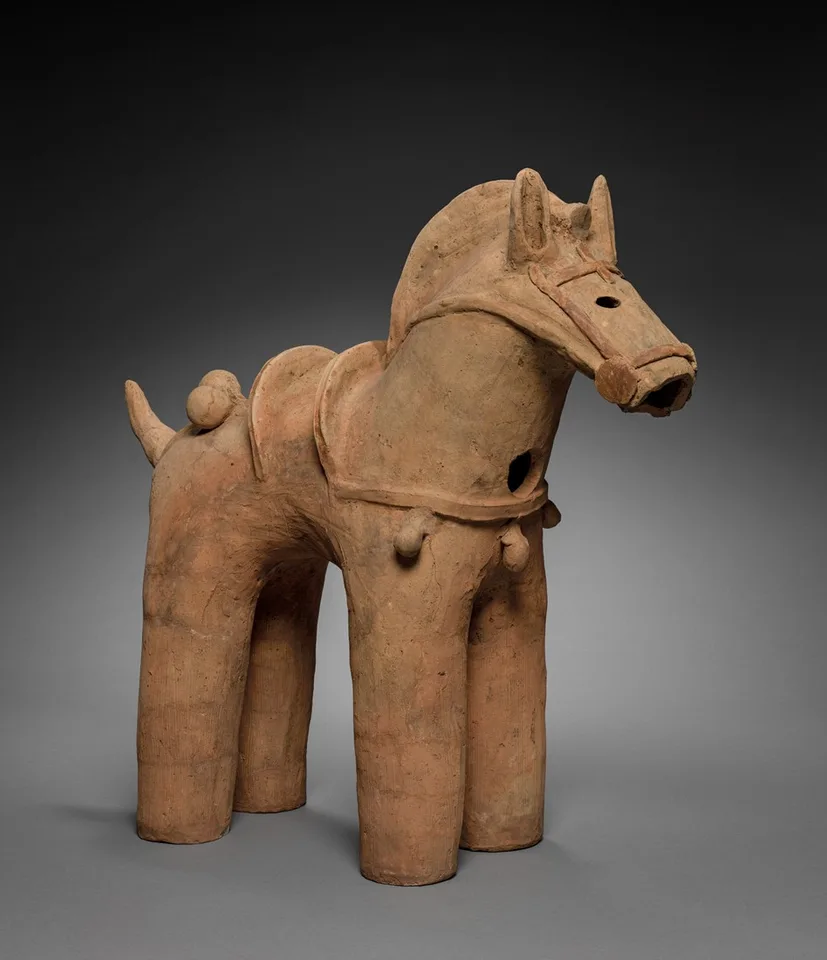
Haniwa Horse

Maker unrecorded · 400s–500s CE

An unglazed terracotta horse stands on four thick cylindrical legs. Its long neck supports a small head with pointed ears, pierced eyes and an open muzzle. Raised straps cross its face and chest, with rounded bells hanging below. A saddle and short raised tail sit on the compact body.
100%

Drag to move · Pinch or +/− to zoom · Arrow keys to pan · 0 to reset

The Cleveland Museum of Art · 1957.27 · Image: CC0Museum image ↗
A little context

Simple clay cylinders become a horse through a few decisive additions: ears, muzzle, saddle and hanging bells.

The horse’s legs remain close to the cylinders from which haniwa developed. Its body is simplified, but the head and equipment provide precise recognition: upright ears, a bridle, a saddle and rounded bells. Those additions turn a robust hollow clay construction into a valuable animal prepared for display. The unglazed surface keeps attention on shape and applied detail.

The museum places the figure within the tomb-mound culture of Kofun-period Japan. Clay cylinders covered mound surfaces, and figures of animals, buildings and people developed over time. The horse’s tack resembles equipment fashionable in Korea during the fifth and sixth centuries, giving the object a regional context of movement and exchange. That comparison does not identify this horse’s maker or owner as a particular migrant. It shows how a simple funerary form can preserve specific information about the appearance of prestigious animals and their equipment.

A careful reading

The equipment’s resemblance to Korean examples supports comparison, not a known biography of this maker or owner. The original mound placement is not supplied by the record.
Try your eye

Which features provide the clearest basis for the museum’s comparison with Korean saddlery?

Where this reading begins

  • Haniwa Horse — collection record — The Cleveland Museum of Art. Supports dating, materials, attribution, provenance and the contextual reading; observations describe the individually inspected museum photograph. Museum record updated 2026-10-02; accessed 2026-11-14.

Our observations describe the supplied museum photograph. Historical identifications and context follow the cited collection record; interpretive limits are stated above. This is an independent guide, not a museum endorsement.

Image rights & attribution

Haniwa Horse (馬形埴輪), 400s–500s CE. Japan, Kofun period (300–710 CE). Earthenware with traces of pigment; overall: 59.7 x 66 cm (23 1/2 x 26 in.). The Cleveland Museum of Art, The Norweb Collection, 1957.27

Individual API record marked CC0; checked 2026-11-14. CC0 1.0 dedication. Record date: 2026-10-02 11:49:13.932000. Museum print JPEG downloaded unchanged and retained; complete overview resized and recompressed as JPEG; responsive WebP and zoom derivatives resized and recompressed; numbered annotation overlay separate from image.