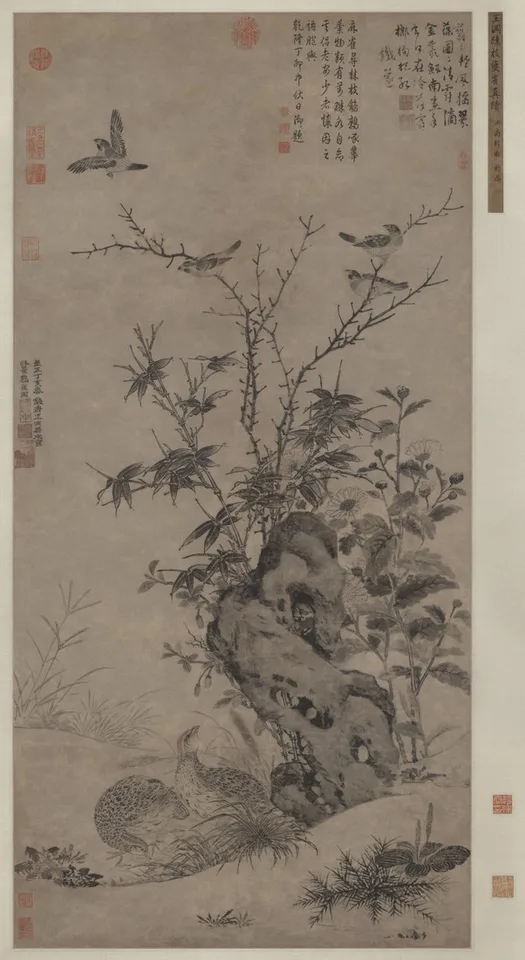
Without bright colour, feathers, leaves and stone must each find their own language of fine lines and soft ink.
Begin with the low, rounded bird, then move upward through the rock and branching stems to the smaller sparrows. Different kinds of marks keep the forms distinct: tiny feather patterns, long narrow leaves, thin twigs and mottled stone. The eye can recognise those differences even though the painting largely withholds the bright colours often associated with bird-and-flower subjects.
The museum describes Wang Yuan’s meticulous adaptation of an academic tradition into monochrome ink. Fine contours and graded washes supply volume without making every subject equally dark. His careful study does not turn the scene into a scientific specimen sheet: the rising rock and scattered birds organise a composed autumn setting. Later seals also record a history of collecting, including the Qing imperial collection. Looking can therefore move between natural forms, the artist’s handling of ink and the marks left by subsequent ownership.
The composed setting is not a scientific record of one observed habitat. Red seals belong to the painting’s collecting history and should not all be attributed to Wang Yuan.
How does the painter distinguish feathers from stone without using strong colour contrasts?
Practise looking at Quails and Sparrows in an Autumn Scene →