Read the
Picture
An open collection
Java, Majapahit Dynasty · Ceramic

Piggy Bank

Unknown maker · 1300s–1400s

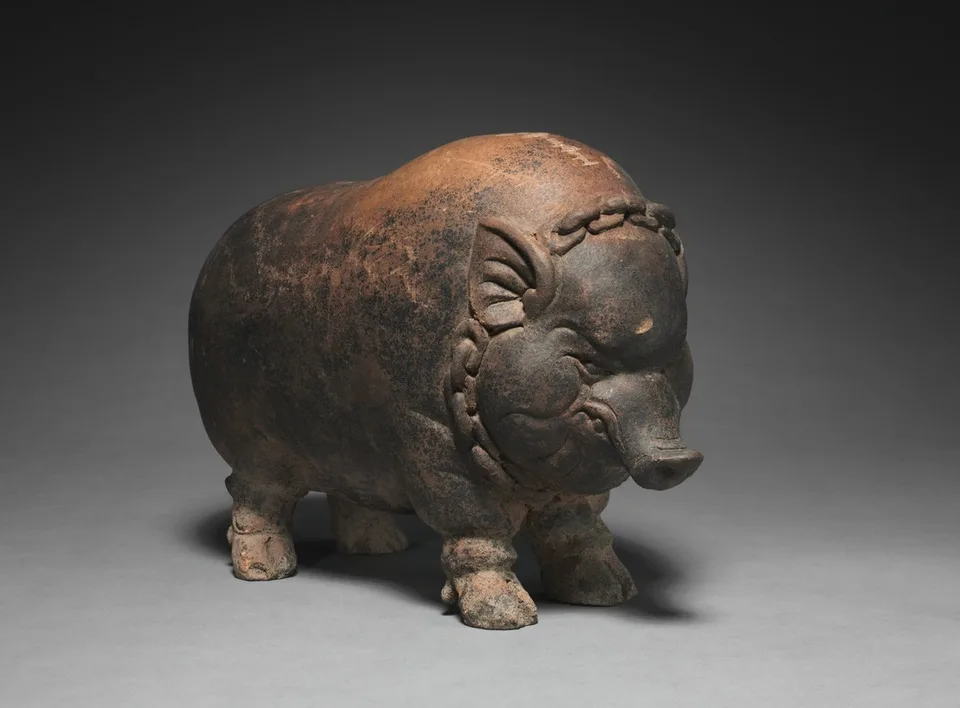
A rounded terracotta pig stands on four short legs, its large body sloping toward a lowered head. A flared snout, sharply shaped ears and heavily modeled cheeks give the face a forceful appearance. Raised chain-like forms cross the neck area. Dark mottling covers much of the reddish clay, with lighter worn patches near the feet.
100%

Drag to move · Pinch or +/− to zoom · Arrow keys to pan · 0 to reset

The Cleveland Museum of Art · 1980.16 · Image: CC0Museum image ↗
A little context

Look at the bulky body and guarded face of a medieval coin container.

The name “piggy bank” is unusually direct here. The rounded animal is also a container for coins, combining a familiar creature with the practical need to store something valuable. Its swollen body provides volume, while short legs make the object compact. The museum identifies a slot on the back, now closed, through which coins could be inserted. That opening is not clearly presented in this view, so the object’s function depends on the catalogue as well as its visible shape.

The face contributes a different kind of evidence. Heavy cheeks, a projecting snout and strongly modeled features make the animal appear guarded rather than placid. The museum reads its fierce expression as a warning against theft and identifies a chain and padlock as references to security. Made in Java during the Majapahit dynasty, this terracotta object survives as an intact container. The record points out that banks of this kind were commonly broken to retrieve their contents. Its survival therefore preserves a form whose ordinary usefulness could also lead to its destruction.

A careful reading

The coin slot is recorded as closed and is not clearly visible from this angle. The photograph cannot show original contents or establish how a particular owner used the bank.
Try your eye

What connects the pig’s exaggerated body with its practical use?

Where this reading begins

  • Piggy Bank — The Cleveland Museum of Art. Individual museum record supplies the qualified identification, material, date and historical context; observations refer to the inspected museum print photograph. Museum record updated 2026-11-13 17:32:23.805000; accessed 2026-11-14.

Our observations describe the supplied museum photograph. Historical identifications and context follow the cited collection record; interpretive limits are stated above. This is an independent guide, not a museum endorsement.

Image rights & attribution

Piggy Bank, 1300s–1400s. Java, Majapahit Dynasty. Terracotta; overall: 24.2 cm (9 1/2 in.). The Cleveland Museum of Art, John L. Severance Fund, 1980.16

Individual API record marked CC0; checked 2026-11-14. CC0 1.0 dedication. Record date: 2026-11-13 17:32:23.805000. Complete museum print photograph resized and recompressed for local overview and WebP derivatives; numbered details are a separate overlay. No cropping or generated replacement.