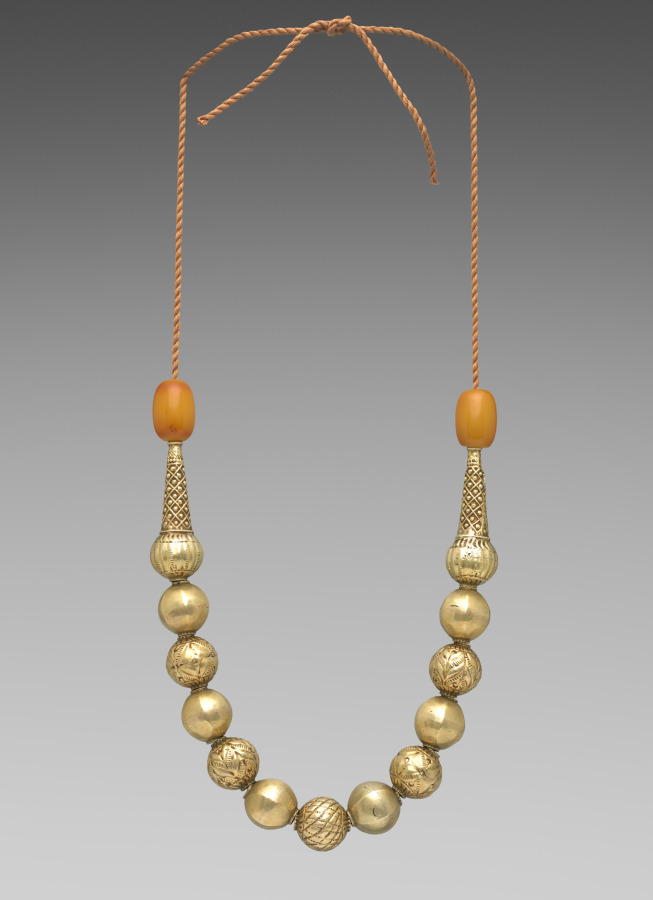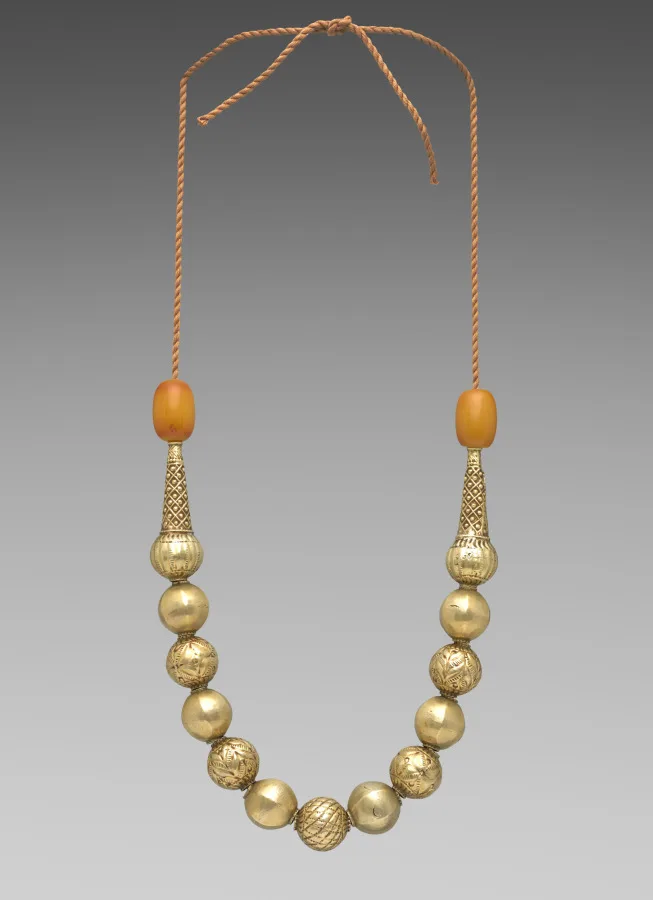
Alternating smooth and intricate gold-toned beads lead upward to two warm yellow elements, linking marriage, craft and imported materials.
Follow the alternation rather than treating the necklace as one continuous golden line. Smooth spheres reflect broad patches of light, while intricate surfaces break the reflection into small marks. The elongated elements near the top change the rhythm again before the warm yellow beads and simple cord. A limited palette contains several distinct kinds of workmanship.
The museum associates this muriya necklace with Muslim women in Harar, Ethiopia, and a bridal trousseau. Its materials signaled both married status and access to imported goods. The metal is gilt silver, so a gold-toned appearance should not be described automatically as solid gold. The yellow substance is less securely identified: the materials field gives tree resin, possibly copal, while the description discusses amber or copal. Preserving that uncertainty is part of reading materials accurately. The necklace's social role is documented more confidently than the precise identity of every component.
The yellow material is recorded as tree resin, possibly copal; amber is also discussed in the description. Its identity cannot be settled by color in a photograph, and the Harar attribution remains qualified in the catalogue.