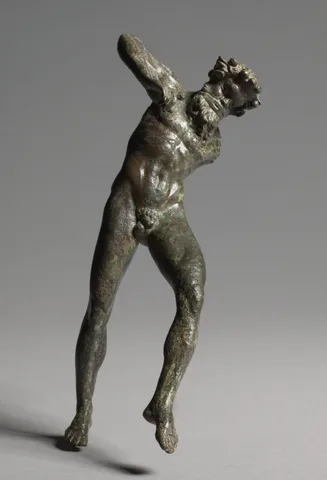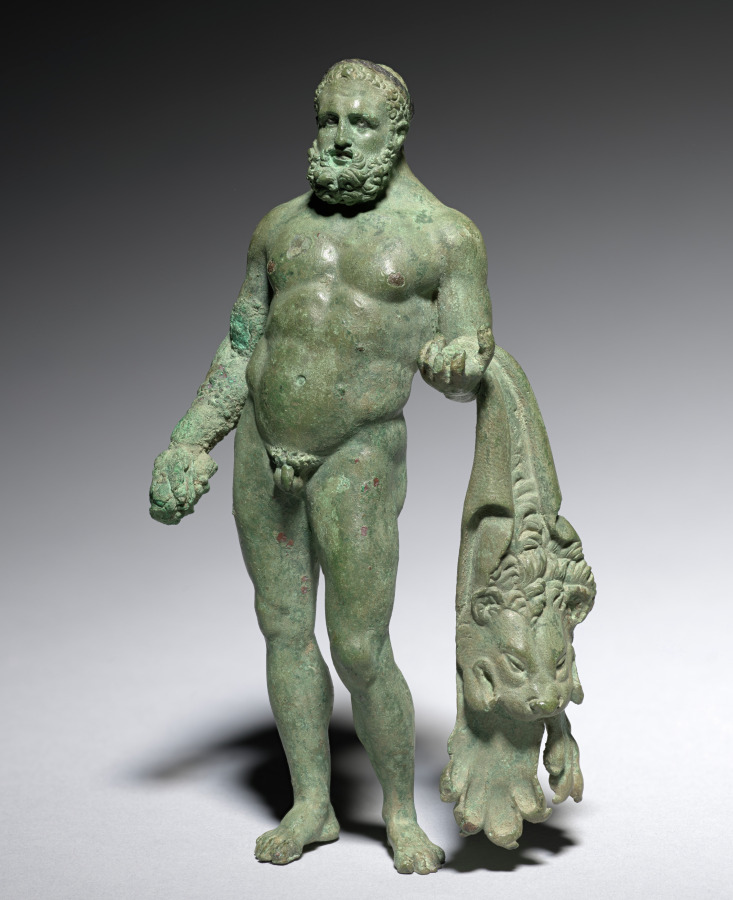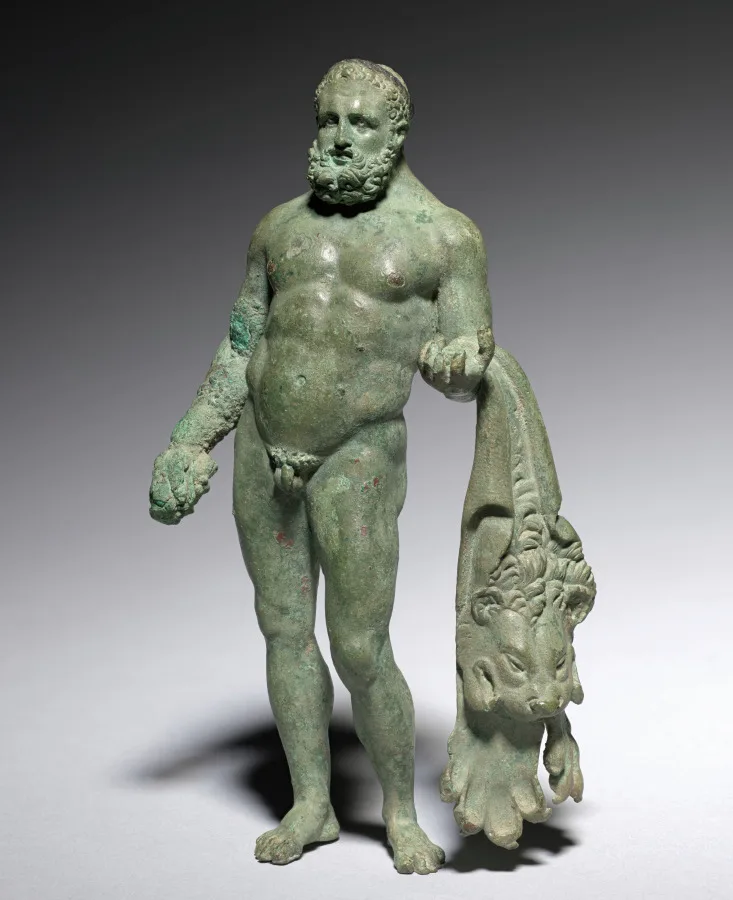
A lion's head hangs beside a muscular man, providing a more specific clue to Hercules than strength alone could offer.
The man's powerful build attracts attention, but the hanging lion skin provides a more precise clue. Its head, mane and paws remain legible as a pelt rather than a second living creature beside him. The body's shifted weight contrasts with the downward pull of this trophy, giving the small sculpture a balanced but asymmetrical form.
The museum identifies Hercules, the Roman form of the Greek hero Herakles. The skin refers to the Nemean lion, defeated as one of his labors. A club, another familiar attribute, was once held in the opposite hand but is now largely lost. These objects identify a narrative role more securely than a muscular body alone. The mature beard also belongs to a Roman preference for presenting the hero with age and strength. Reading the figure means combining what survives, what the record reconstructs and what the particular heroic story makes meaningful.
The club survives only fragmentarily. A muscular bearded man is not automatically Hercules in every image; the lion skin and documented narrative context provide the more specific evidence here.