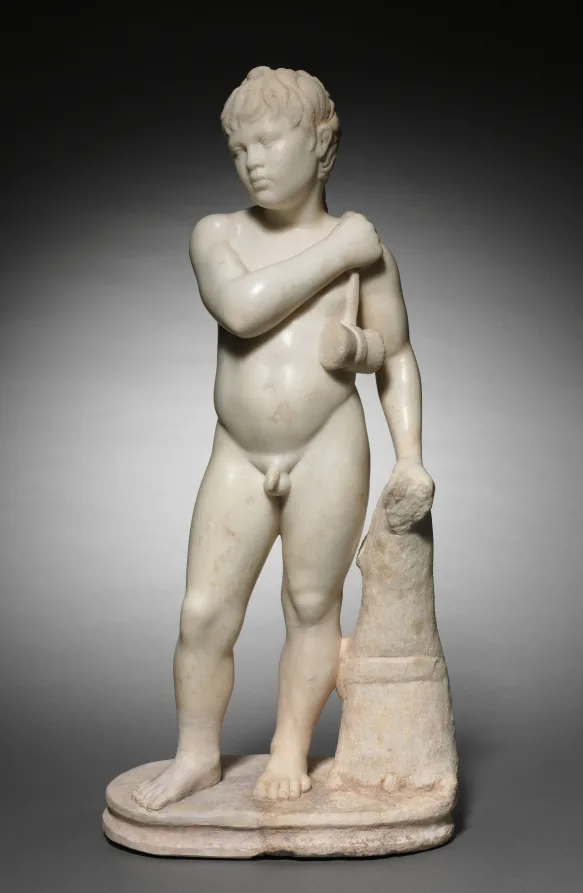
An hourglass-shaped weight and a bag-like support turn a resting youth into an athlete, while a restored leg complicates apparent completeness.
The pose initially looks like a quiet moment of rest. One arm crosses the chest, the other leans on a support, and the head turns slightly aside. Then the equipment changes the reading. An hourglass-shaped weight at the shoulder and an animal-skin punching bag identify a body involved in athletic practice rather than a generic standing youth.
The museum places this Roman sculpture in the first century CE and notes several related examples that suggest a lost common prototype. The hairstyle may refer to a childhood vow, but that proposal is less secure than the visible equipment. The lower right leg and foot are reconstructed, another important distinction when the whole figure seems complete at first glance. Read the supported posture and athletic objects with confidence, while preserving uncertainty about the hair's meaning and awareness of restoration. A finished museum presentation can contain both ancient carving and later additions.
The lower right leg and foot are reconstructed. The hairstyle's connection with a childhood vow and the existence of a shared lost prototype are proposals, not facts readable directly from the photograph.