Read the
Picture
An open collection
Greece, Alexandria(?) · Metalwork

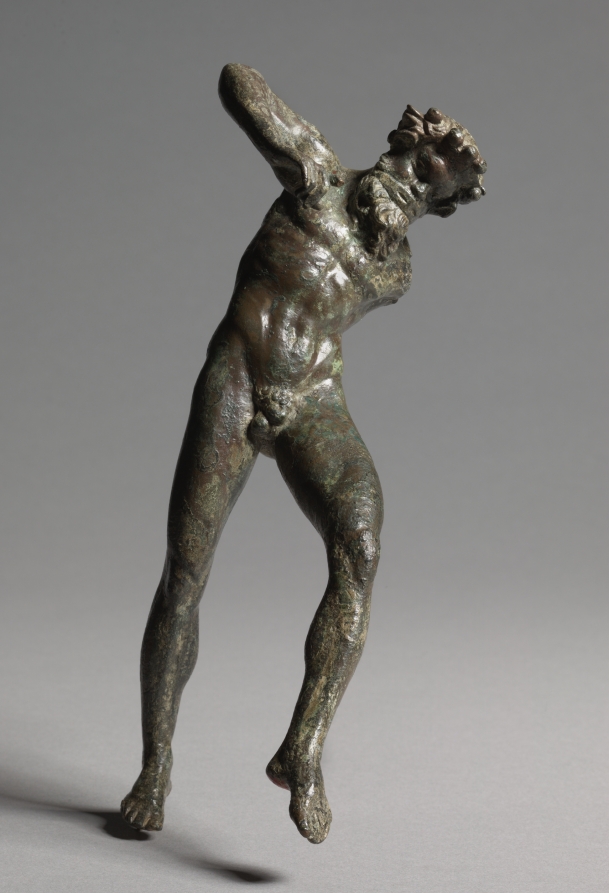
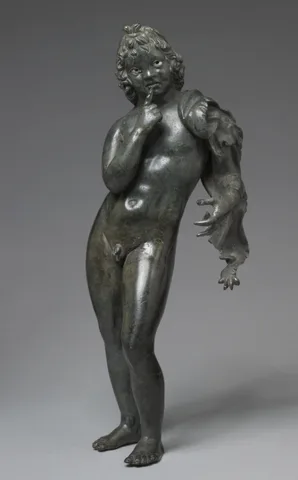
Piping and Dancing Satyr

Maker unrecorded · 300–100 BCE

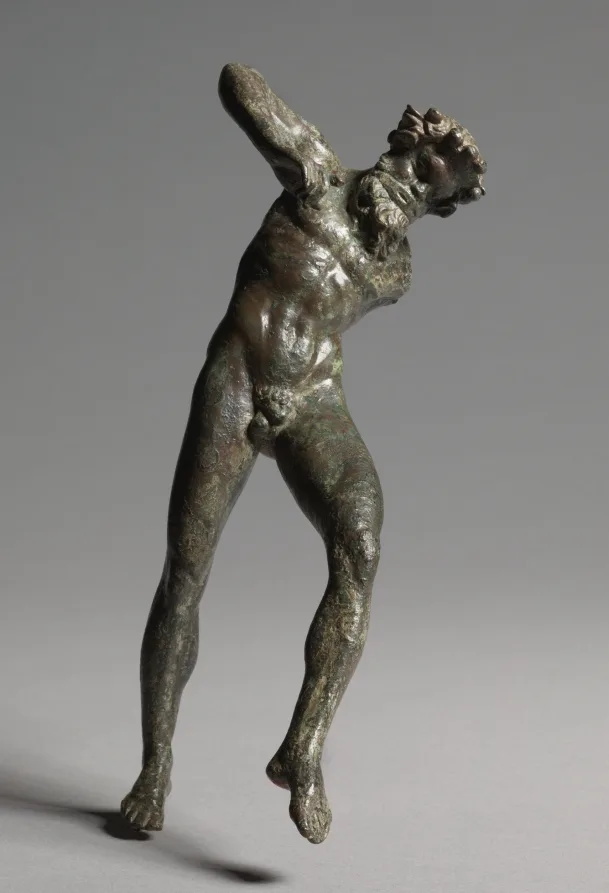
A bronze male figure twists sideways with a tilted head and bent, uneven legs. One arm is missing and the surviving raised arm is incomplete. Curly hair or a crown surrounds the head, with a pointed ear visible at the side. The torso is strongly modeled, and both feet appear poised in a shifting dance step.
100%

Drag to move · Pinch or +/− to zoom · Arrow keys to pan · 0 to reset

The Cleveland Museum of Art · 1945.366 · Image: CC0Museum image ↗
A little context

A tilted torso and uneven legs preserve a dance, while a mouth strap helps explain the musical pipes now missing.

The body's balance seems temporary. One shoulder rises, the torso bends and the legs do not settle into a symmetrical stance. These choices suggest a moment within a dance rather than a resting figure. Damage has removed parts of the action, but the surviving body's direction still gives the eye a clear sense of movement.

The museum identifies a satyr through pointed ears, a snub nose and a berry crown. Followers of Dionysos could combine human and animal traits, so this is not simply an anonymous dancing man. A strap at the mouth and the surviving hand's position suggest that he once played auloi, or musical pipes. The instrument itself is missing, and that reconstruction should remain qualified. The sculpture was assembled from several cast pieces, a method that allowed an ambitious pose. Its missing parts reveal the limits of a surviving image without erasing what the body still communicates.

A careful reading

The musical pipes are reconstructed from the hand and mouth strap rather than preserved in full. The proposed Alexandrian origin is uncertain, and the absent arm should not be supplied with an invented exact gesture.
Try your eye

Which claim should remain qualified because the relevant object is missing?

Where this reading begins

  • Piping and Dancing Satyr: collection record — The Cleveland Museum of Art. Object identification, attribution, materials, historical context and stated uncertainties; observations independently checked against the museum photograph. Museum record updated 2026-06-17; accessed 2026-11-13.

Our observations describe the supplied museum photograph. Historical identifications and context follow the cited collection record; interpretive limits are stated above. This is an independent guide, not a museum endorsement.

Image rights & attribution

Piping and Dancing Satyr, 300–100 BCE. Greece, Alexandria(?). Bronze; overall: 21 cm (8 1/4 in.). The Cleveland Museum of Art, Purchase from the J. H. Wade Fund, 1945.366

Individual API record marked CC0; checked 2026-11-13. CC0 1.0 dedication. Record date: 2026-06-17 11:19:43.673000. Web JPEG downloaded unchanged; responsive WebP and zoom derivatives resized and recompressed; numbered annotation overlay separate from image.