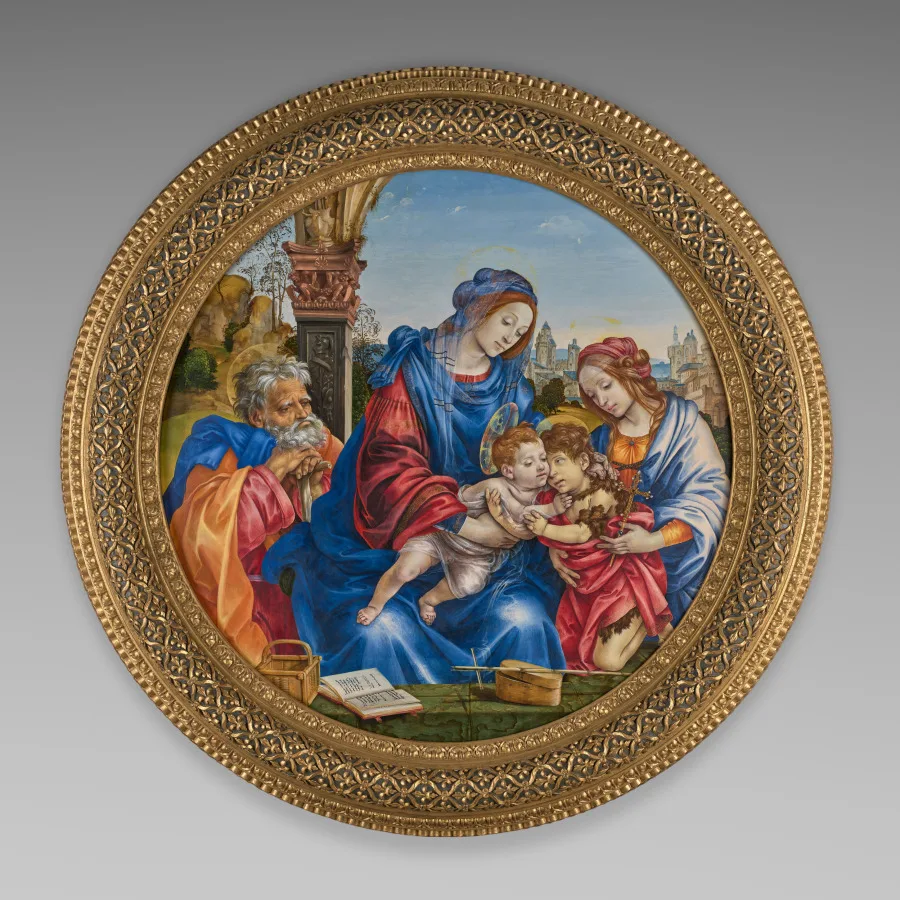
A circle gathers five figures into a close embrace, while small objects along the front ledge slow your eye.
The circle is not just a decorative border: it is a compositional problem. Lippi fits five figures into it by overlapping arms, cloth, and bodies around the two embracing children. The museum identifies Mary with Christ at the center, John the Baptist supported by Saint Margaret at the right, and Joseph watching from the left. Their relationship is built through touch and direction rather than a row of separately posed figures.
The museum associates this painting with a commission by Cardinal Oliviero Carafa during Lippi’s years in Rome. It connects its forms and background with the artist’s close study of ancient sculpture and architecture. Yet the work also makes room for ordinary-looking things on the front ledge: a book and small containers sit between the sacred group and our space. Begin with those objects, then follow the layered figures upward. The picture brings scholarly artistic reference, devotional subject matter, and carefully arranged domestic detail into one richly colored surface.
The museum’s identification of the figures supplies context that costume alone cannot establish. An object on the ledge should not be assigned a symbolic meaning simply because it appears within a religious painting.
How does Lippi fit the central group into a circular format?
Practise looking at The Holy Family with Saint John the Baptist and Saint Margaret →