Read the
Picture
An open collection
France · Painting

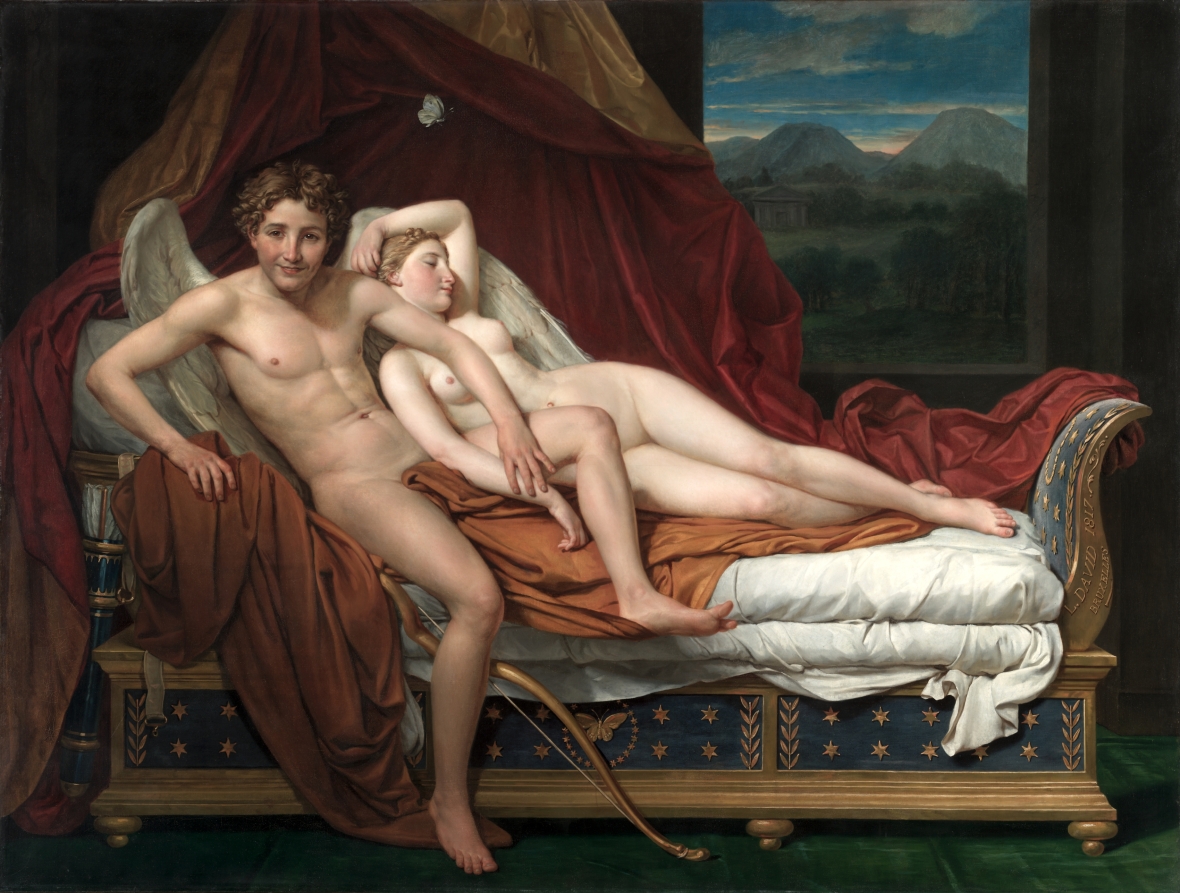
Cupid and Psyche

Jacques-Louis David (French, 1748–1825) · 1817

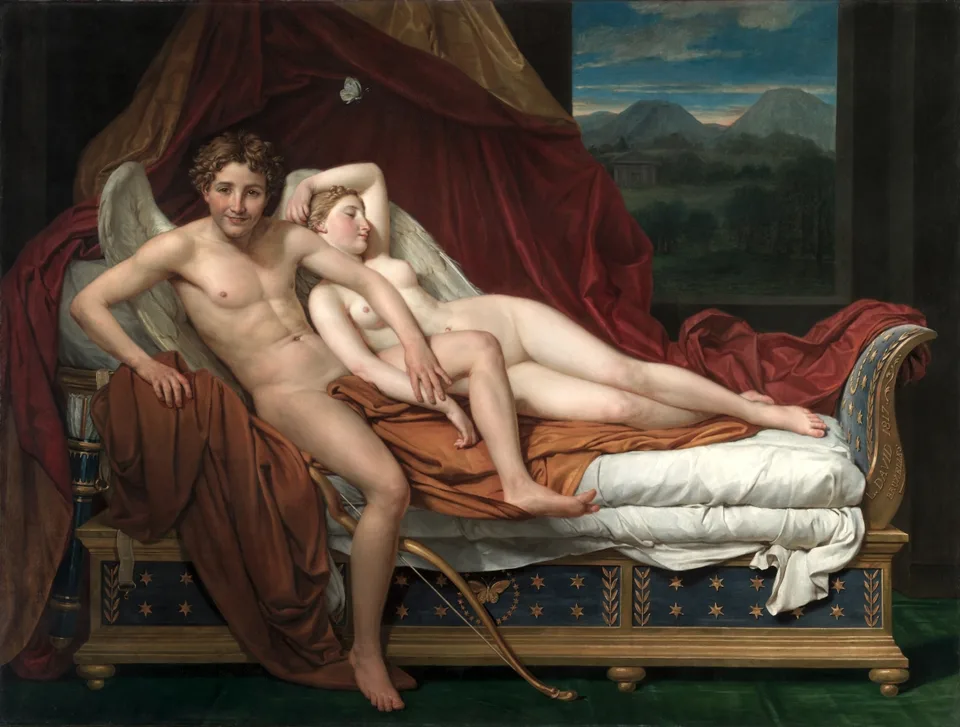
Two nude figures recline on a richly upholstered bed beneath deep red curtains. A winged young man at left looks toward the viewer while a young woman lies asleep beside him. A bow rests against the bed, a pale butterfly floats above, and a distant blue landscape is visible through an opening.
100%

Drag to move · Pinch or +/− to zoom · Arrow keys to pan · 0 to reset

The Cleveland Museum of Art · 1962.37 · Image: CC0Museum image ↗
A little context

A wing, a bow, and an unexpected grin turn a luxurious bedroom into a particular story about love.

At first this seems a beautifully ordered scene: a red canopy, pale bedding, and bodies arranged across a grand couch. Then the awake figure looks directly out of the picture. His smile interrupts the sleeping figure’s calm and the room’s ceremony. David is painting the classical story of Cupid and Psyche, in which a god visits a mortal lover while concealing his identity from her.

The wing and bow help identify Cupid, but recognizing an attribute is only the beginning. The museum describes David’s treatment as a tension between ideal love and physical reality. His Cupid is deliberately less serene than an idealized god might be. Follow the smooth curve of Psyche’s sleeping body, then return to Cupid’s face: the two figures invite different kinds of attention. The butterflies are further details to notice, but they should be read within this particular classical subject, rather than treated as a universal code for every butterfly in art.

A careful reading

The story is a myth, and David’s treatment is an interpretation of it. We can observe the expression and pose without assuming that every viewer will read Cupid’s smile in precisely the same way.
Try your eye

Which pair offers the strongest visible clues to Cupid’s identity?

Where this reading begins

  • Cupid and Psyche — collection record — The Cleveland Museum of Art. Explains David’s treatment of Cupid and Psyche as a tension between ideal love and physical reality and identifies two butterflies. The wing, gaze, bow and airborne butterfly are separately visible. 2026-11-07; accessed 2026-11-16.

Our observations describe the supplied museum photograph. Historical identifications and context follow the cited collection record; interpretive limits are stated above. This is an independent guide, not a museum endorsement.

Image rights & attribution

Cupid and Psyche, 1817. Jacques-Louis David (French, 1748–1825). Oil on canvas; framed: 221 x 282 x 10 cm (87 x 111 x 3 15/16 in.); unframed: 184.2 x 241.6 cm (72 1/2 x 95 1/8 in.). The Cleveland Museum of Art, Leonard C. Hanna Jr. Fund, 1962.37

Individual API record marked CC0; checked 2026-11-13. CC0 1.0 dedication. Record date: 2026-11-07 15:30:02.936000. Web JPEG downloaded unchanged; responsive WebP and zoom derivatives resized and recompressed; numbered annotation overlay separate from image.