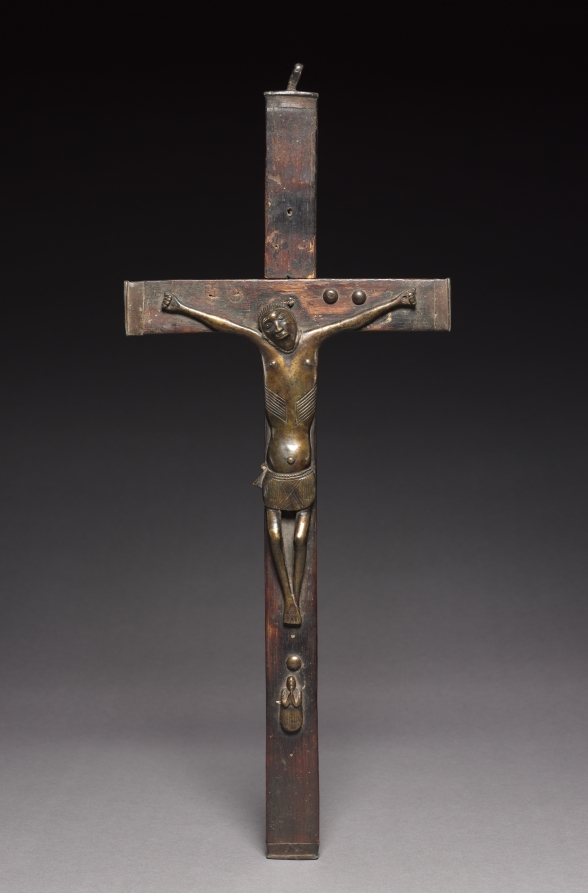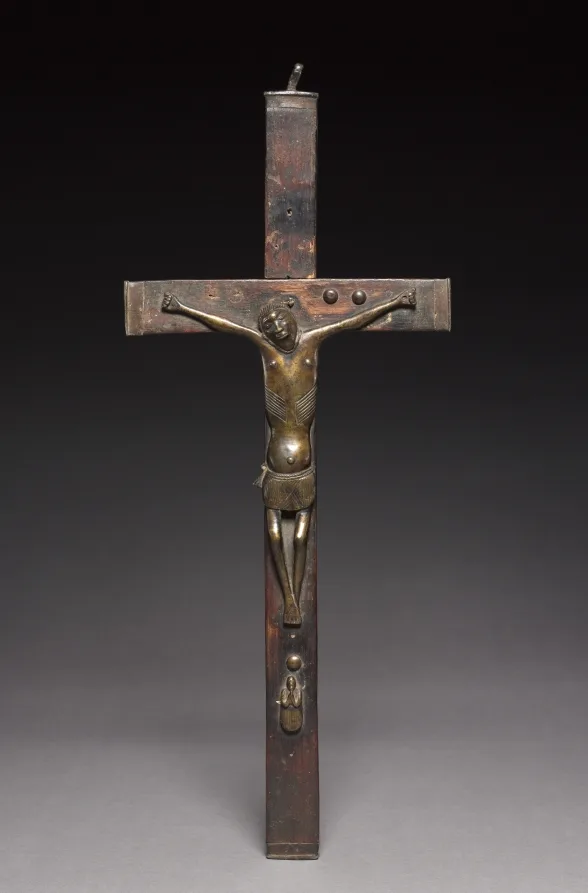
Look below Christ’s feet and at his waist: a familiar Christian form carries a specifically Kongo history.
The basic shape is immediately recognizable as a crucifix, but recognition is only the beginning. A metal figure is fastened to a tall wooden cross; below his feet, a second, much smaller figure occupies the same vertical line. The close arrangement asks viewers to move from Christ's body to a figure of devotion or mourning beneath it.
This work comes from the Kongo Kingdom, where Catholicism had an established history following King Nzinga a Nkuwu's conversion in 1491. It was made centuries later by local makers using wood, metal and studs. The museum connects Christ's braided hairstyle to Kongo men's appearance and the incised cross on his waist wrapper to the dikenga dia Kongo, a diagram associated with the cycle of life. The sculpture is evidence of Christianity taking a particular local form, not simply a European image reproduced without change.
The small lower figure is identified as either the Virgin Mary or a worshiper; its identity is not certain. The museum’s connection between the wrapper’s design and the Kongo life cycle is contextual interpretation.