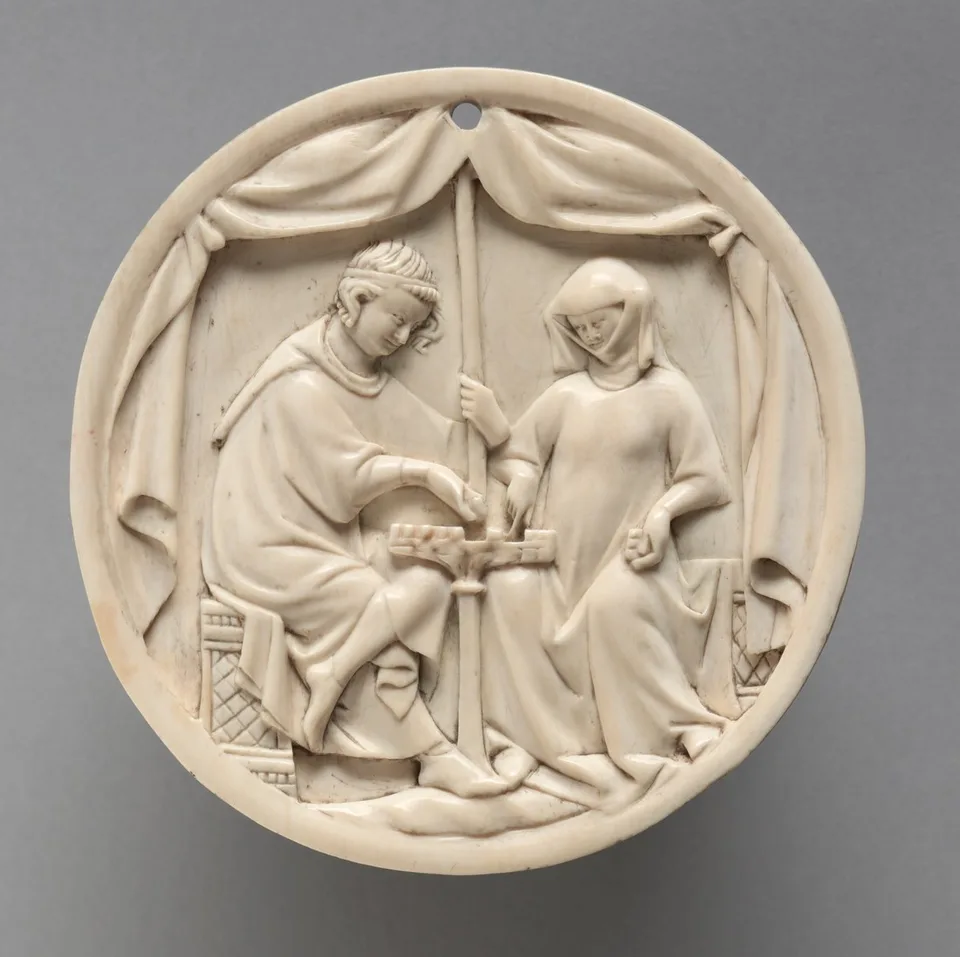
A chessboard brings two courtly figures close together on an object once handled while looking at one’s own reflection.
The circular boundary fits around the seated pair and their curtains. The man’s hands converge over the little board, while the woman holds small pieces beside it and grips the central curtain support with her other hand. The shared game connects their differently posed bodies. The man leans toward the pieces, while the woman’s body stays more upright. Their drapery folds spread downward to fill the curved lower edge, turning a small functional object into a complete scene.
The museum identifies this as a mirror back made in fourteenth-century Paris, a center of luxury ivory production for aristocratic patrons. Chess could evoke both love and conflict in medieval imagery, and mirror backs often presented courtship or chivalrous encounters. Suggestions that the pair represents Tristan and Iseult or Lancelot and Guinevere remain unproven. The visible game is a firmer starting point than either literary name. Its intimate scale also matters: the carved encounter belonged to personal use and elite display rather than a public narrative monument.
The couple’s proposed literary identities remain uncertain. The mirror itself is absent, and the surviving carved back cannot establish its owner or the precise circumstances in which it was used.
Which identification is securely supported by the image and record?
Practise looking at Mirror Case with a Couple Playing Chess →