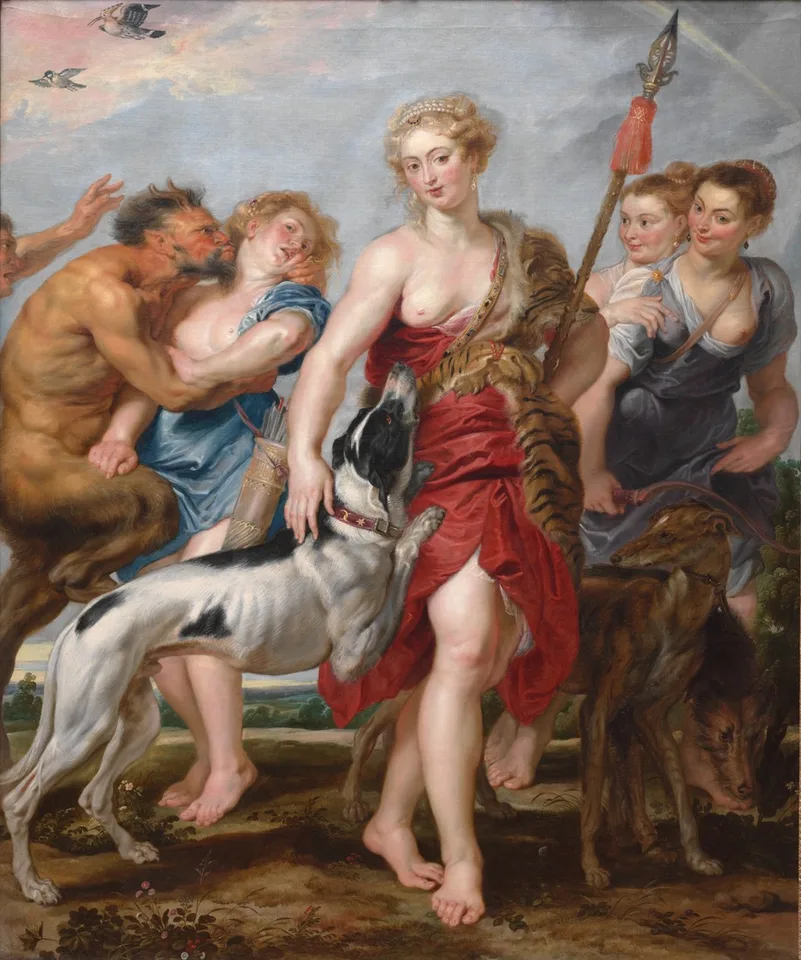
Diana steps toward us while a struggle at the edge interrupts the apparent confidence of her hunting party.
The figures crowd the foreground so closely that Diana’s forward step seems to enter our space. Red drapery gathers around her body, and a large pale dog stretches upward beside her. At the left, a nymph resists a satyr’s advance. The museum reads this confrontation as a moral tension between vice and virtue within an image that also displays sensual bodies.
Diana’s crescent identifies her association with the moon, while dogs and the spear establish the hunt. The record credits Rubens and his workshop, preserving the collaborative character of production. The object’s later history also matters: Nazi authorities confiscated it from the Rothschild collection in 1940, and it entered Hermann Goering’s possession before Allied recovery. It was restituted to Édouard and Germaine de Rothschild in 1948 and acquired by Cleveland in 1959. That documented sequence is distinct from, but no less consequential than, the story represented in paint.
The museum’s moral reading does not erase the coercive advance visible at the left. Workshop credit and the documented seizure-and-restitution history should remain part of the painting’s account.
Which detail most specifically identifies the central figure as Diana?
Practise looking at Diana and Her Nymphs Departing for the Hunt →