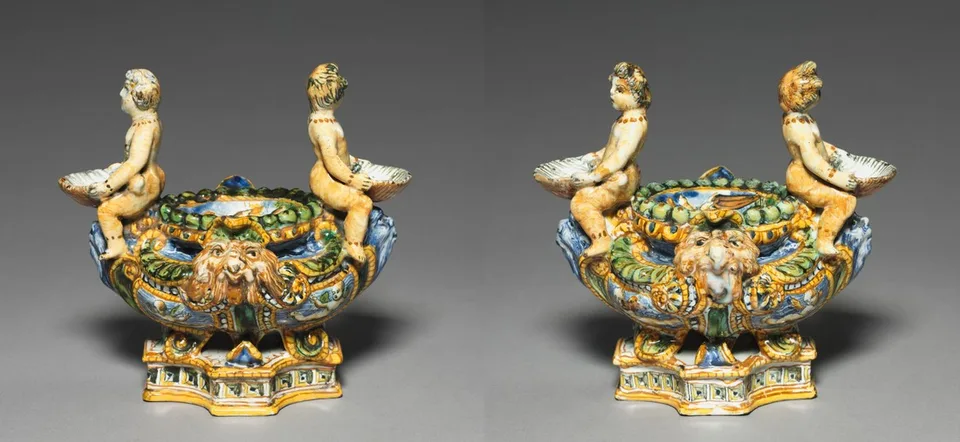
Small dining containers become crowded sculptural displays, with paired figures and masks making salt part of an elaborate table setting.
The two vessels repeat the same basic form: a rounded central container, a low shaped base, and seated figures rising at either side. Their bright painted details make it difficult to isolate a single plain surface. Masks, scrolls, and shell-like forms turn the containers into miniature sculptural arrangements, while the paired presentation doubles their decorative rhythm.
The museum attributes these saltcellars to the circle of the Patanazzi family in Urbino, around 1570–90. It situates maiolica within the display culture of Renaissance nobles and merchants, who commissioned ceramics for dining as well as storage and exhibition. Tin glaze supplied an opaque white surface that could receive vivid painted ornament. Here, three-dimensional modeling and color work together: the figures alter the outline, while painted motifs enrich the smaller surfaces. The object’s scale does not make its social function modest; salt was an expensive commodity in the Renaissance, and these conspicuously elaborate containers made its presentation part of the display.
The attribution is to the Patanazzi family’s circle, not a named individual maker. The museum does not establish a particular banquet or original owner for this pair.