Read the
Picture
An open collection
A guided journey · 5 works

Stories around the table

Some objects tell stories around a represented table; others participated in the practical ceremony of dining. Follow a mythological procession and a biblical banquet into a courtly game, then examine actual salt containers and a pouring vessel. These connections concern gesture, display, and social use, while keeping narrative violence, luxury ornament, and everyday function distinct.

Begin the journey ↓
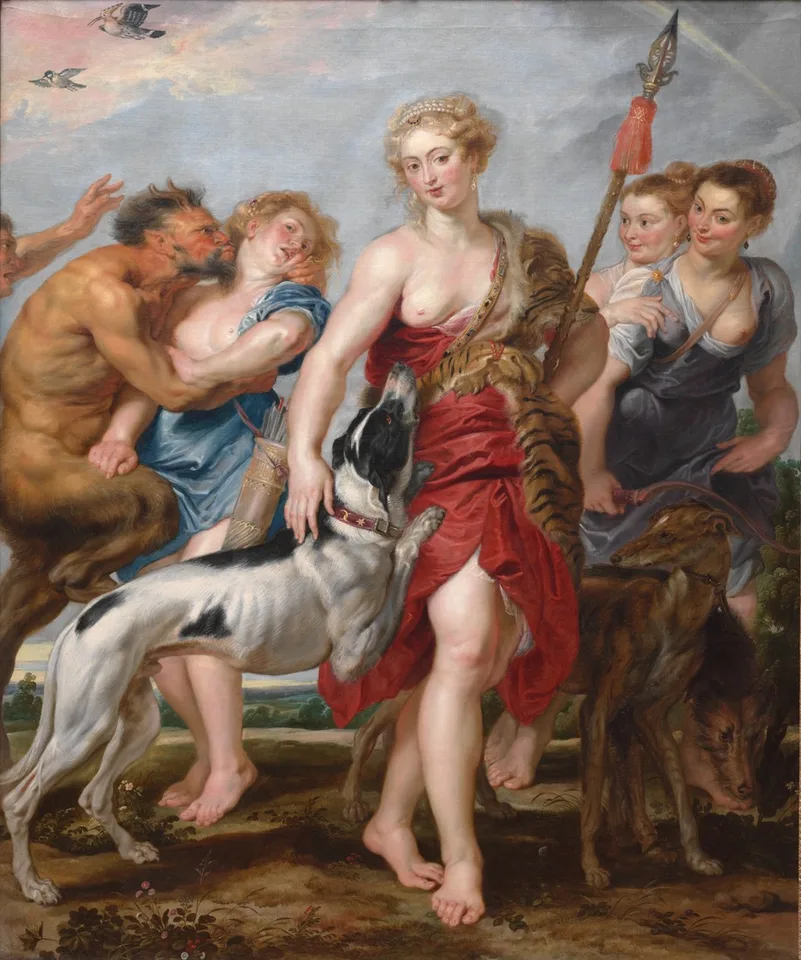
A nearly life-size group of women advances toward the viewer beside several dogs. The central woman wears red drapery and an animal skin, with a crescent on her forehead. At left, a muscular satyr presses toward a woman who pushes him away. A spear rises at right beneath a blue-gray sky.
01A nearly life-size group of women advances toward the viewer beside several dogs. The central woman wears red drapery and an animal skin, with a crescent on her forehead. At left, a muscular satyr presses toward a woman who pushes him away. A spear rises at right beneath a blue-gray sky.
Diana and Her Nymphs Departing for the Hunt · c. 1615

Resistance at the left

A nymph’s resistance interrupts the hunting party’s confident advance. The mythological reading should preserve that action, alongside workshop credit and the painting’s documented seizure-and-restitution history.

Carry this question: Which gesture disrupts the apparent unity of the group?

Open the artwork ↗
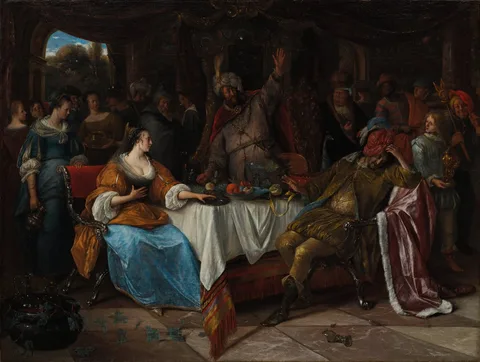
02A richly dressed woman sits at the left of a banquet table, extending an open hand toward a man reclining at the right. A crowned or turbaned ruler stands behind the table with one arm raised. Attendants crowd the dark interior. Bright blue, white, gold, and pink fabrics surround fruit, vessels, and a pale tablecloth.
Esther, Ahasuerus, and Haman · c. 1668

Haman sinking back

Haman’s slumped body shows a reversal of power at a banquet. Esther’s appeal and the king’s rising gesture turn dining furniture into the stage of a political crisis.

Carry this question: What changes when costly clothing is carried by a collapsing pose?

Open the artwork ↗
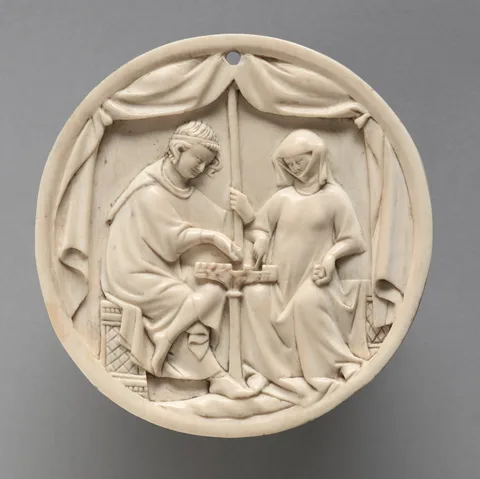
03A round ivory relief shows a seated man and woman facing one another across a small chessboard. The man reaches over the pieces while the woman holds small pieces beside the board, and draped garments gather around their knees. Curtains hang in scalloped folds above and at the sides. Fine carved hair, furniture patterns, and a small hole near the top enrich the pale circular object.
Mirror Case with a Couple Playing Chess · 1325–50

The small chessboard

A small chessboard connects two courtly figures on a mirror back. The game’s associations with love and conflict do not securely identify the pair as particular literary lovers.

Carry this question: How does the board organize the distance between the figures?

Open the artwork ↗
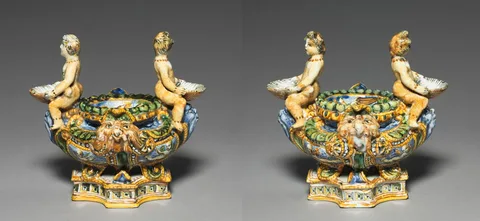
04Two matching ornate ceramic vessels stand side by side on small decorated bases. Each rounded bowl is supported and surrounded by sculpted masks, scrolls, and small seated nude figures holding shell-like forms. Bright blue, yellow, green, and orange painted details cover their pale surfaces. Their matching shapes create a balanced pair against a neutral background.
Pair of Saltcellars · c. 1570–90

A projecting mask

Move from represented luxury to actual table equipment. Projecting masks and modeled figures make salt containers into miniature displays, while the workshop-circle attribution remains qualified.

Carry this question: Where does ornament interrupt the useful bowl shape?

Open the artwork ↗
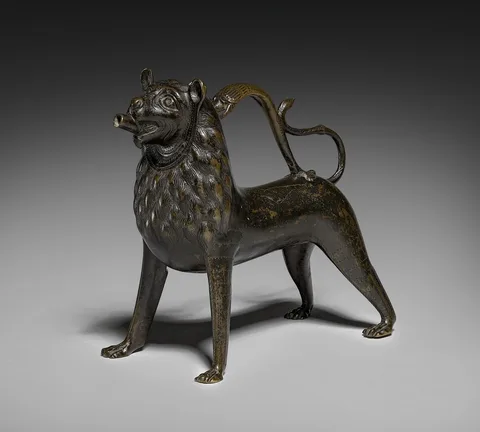
05A dark bronze lion stands on four long legs with its head raised and mouth open. Repeated textured locks form a mane around the neck and chest. An arched handle runs from the head area to the back, and a thin tail curls upward behind it. Incised and punched details cover parts of the body.
Lion Aquamanile · 1200–1250

The arched handle

The lion’s arch is also a handle, completing a shift from narrative bodies to an animal-shaped tool. Washing could belong to religious or elite domestic settings; this vessel’s first setting is unknown.

Carry this question: How does the grip shape the animal’s silhouette?

Open the artwork ↗
Take this with you

Compare the social work of gestures and objects without assuming that similar luxury settings carried identical meanings.

Try an exercise with the first work →

Find another journey →

Read with the sources

Historical context follows the individual museum records linked on each artwork page. These routes make original comparisons of visible form; resemblance alone is not evidence of shared meaning or direct influence.