Read the
Picture
An open collection
Germany, Lower Saxony, Hildesheim, Gothic period, first half 13th century · Sculpture

Lion Aquamanile

Maker unrecorded · 1200–1250

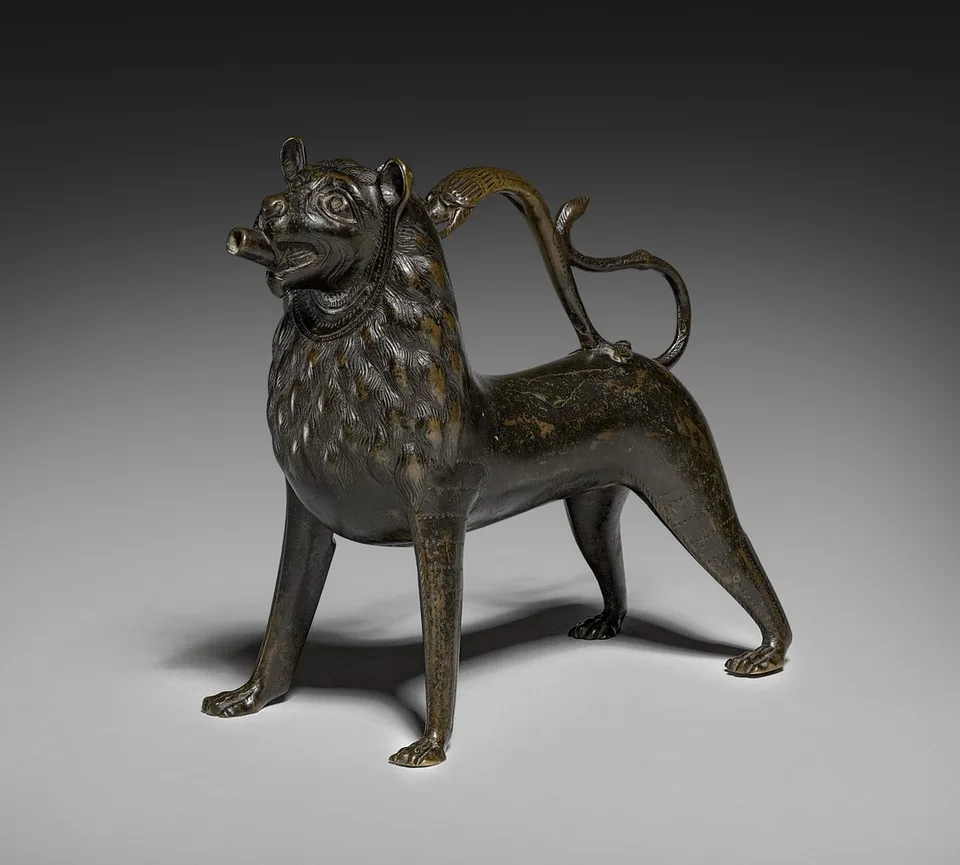
A dark bronze lion stands on four long legs with its head raised and mouth open. Repeated textured locks form a mane around the neck and chest. An arched handle runs from the head area to the back, and a thin tail curls upward behind it. Incised and punched details cover parts of the body.
100%

Drag to move · Pinch or +/− to zoom · Arrow keys to pan · 0 to reset

The Cleveland Museum of Art · 1972.167 · Image: CC0Museum image ↗
A little context

The lion’s open mouth and arched back handle reveal that this animal was also a vessel for pouring water.

At first the object looks like an alert animal sculpture. The high head, open mouth, long legs, and curled tail give it a lively silhouette. A second look reveals the large arch joining neck and back. That arch is a handle, and the body is a container: animal form has been adapted to the movements of carrying and pouring.

An aquamanile was used for washing hands, either at church altars or at the tables of wealthy patrons. The museum explains that such vessels could take the form of real or fantastic animals. This German example chooses a lion, whose textured mane distinguishes the front of the vessel from its smoother body. Its purpose therefore depended on a sequence of actions beyond static display. Someone lifted it, directed the water, and used a separate basin to catch the flow. The photograph preserves its elaborate shape but cannot reproduce that handled experience.

A careful reading

Aquamaniles served both religious and elite domestic washing. The record does not establish which setting this particular lion originally occupied, or identify a specific medieval owner.
Try your eye

What most clearly shows that the lion is also a useful vessel?

Where this reading begins

  • Lion Aquamanile — collection record — The Cleveland Museum of Art. Identifies German Gothic cast/chased/punched bronze handwashing vessel, religious or elite dining use, and dragon-shaped handle. 2026-06-17; accessed 2026-11-16.

Our observations describe the supplied museum photograph. Historical identifications and context follow the cited collection record; interpretive limits are stated above. This is an independent guide, not a museum endorsement.

Image rights & attribution

Lion Aquamanile, 1200–1250. Germany, Lower Saxony, Hildesheim, Gothic period, first half 13th century. Bronze: cast, chased, and punched; overall: 26.4 x 29 x 15 cm (10 3/8 x 11 7/16 x 5 7/8 in.). The Cleveland Museum of Art, Gift of Mrs. Chester D. Tripp in honor of Chester D. Tripp, 1972.167

Individual API record marked CC0; checked 2026-11-14. CC0 1.0 dedication. Record date: 2026-06-17 11:19:44.429000. Museum print JPEG retained unchanged as original. Overview JPEG and responsive WebP and zoom derivatives resized and recompressed from that same complete print photograph; numbered annotation overlay separate from image.