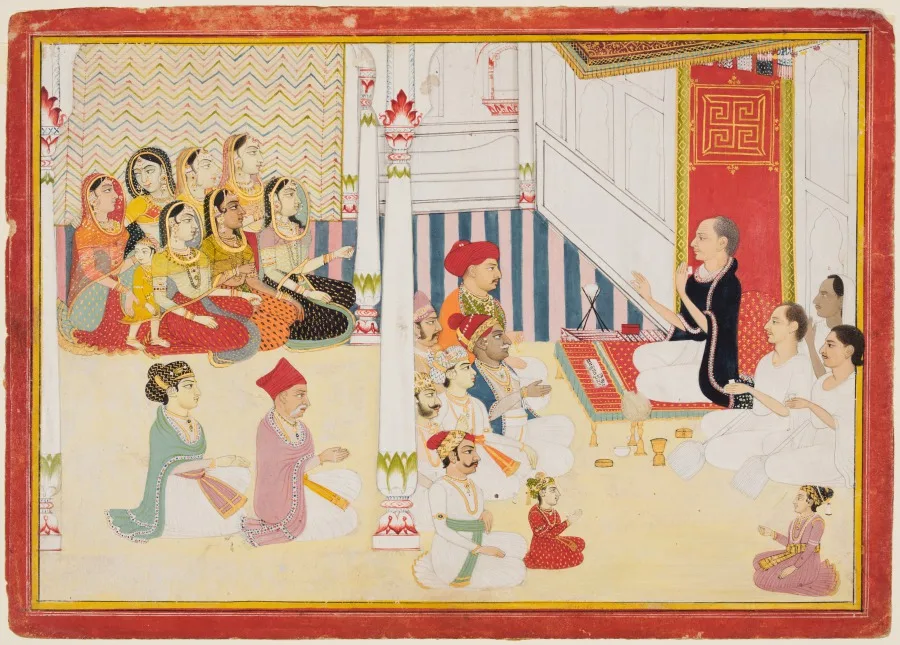
A raised hand, a manuscript and a cloth at the mouth reveal different parts of a carefully arranged teaching encounter.
Look first at the teacher’s two hands. One rises toward the listeners, while the other brings a pale cloth toward his mouth. The manuscript in front of him anchors the spoken lesson in a written text. The museum identifies a Shvetambara Jain teacher addressing laypeople, with men toward the foreground and women farther back. The picture organises a social encounter through posture, clothing, and the placement of its groups.
The museum describes the teacher and the white-clad companions as householder monks, whose practices could include scribal work and the care of manuscript libraries in Rajasthan. The cloth protects insects, while the coloured shawl indicates elevated status in this particular setting. These details require local context: a cloth is more than an accessory, and a manuscript is more than decoration. The painting is possibly by Sahib Ram, a qualification that should remain visible even as its precisely arranged figures make the event appear confidently observed.
The attribution to Sahib Ram is tentative. This scene describes a particular Jain teaching setting and should not be treated as a complete account of every Jain monastic practice, dress convention or community.
Why does the teacher hold a cloth near his mouth?
Practise looking at Shvetambara Jain Teacher Giving Instruction →