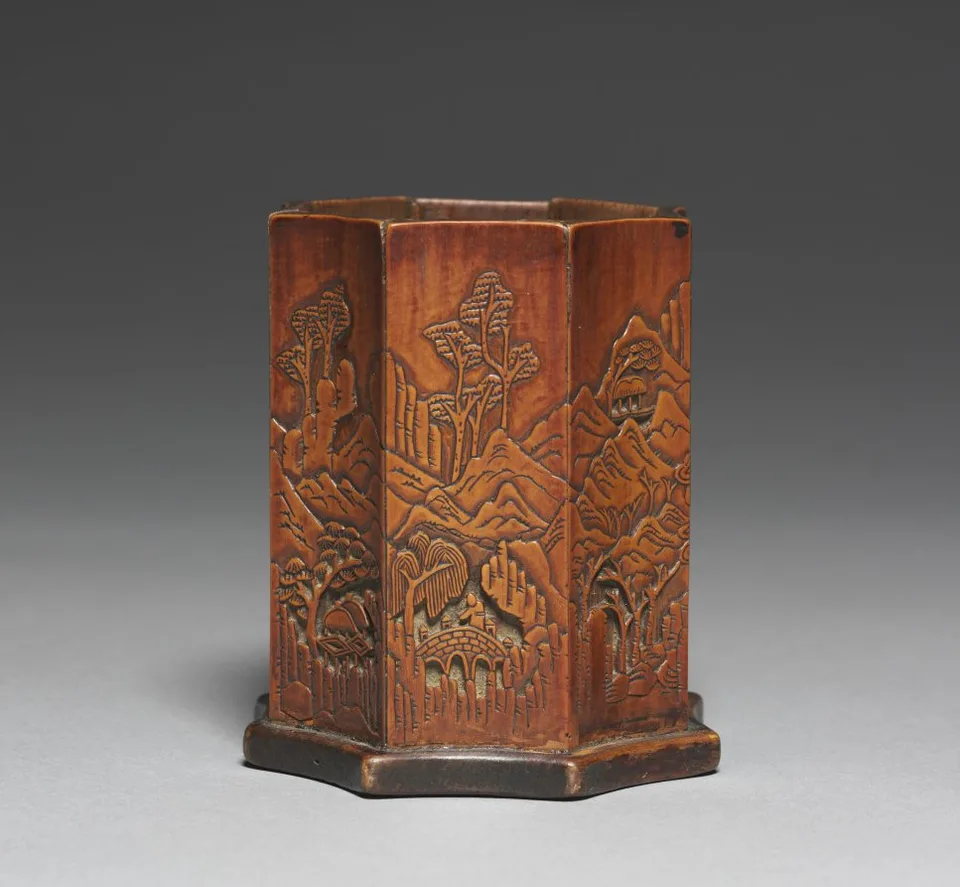
A mountain landscape wraps around a scholar’s practical tool, making the desk itself a place to display cultivated taste.
The holder is useful before it is pictorial: its open top makes space for writing brushes. Yet the exterior gives the eye a miniature world of rocks, trees, and buildings. Carved lines follow the faces of the container, so a landscape that appears continuous also changes with the object’s angled sides. The view shown here can only reveal part of that wrapping design.
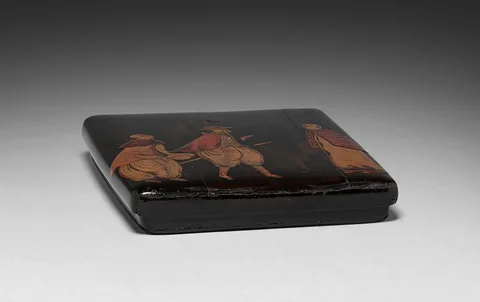
The museum places such objects within the collecting culture of late Joseon Korea, when finely made writing tools could express learned taste. It cites discussions that distinguished elegant scholarly possessions from other kinds of luxury. This does not make the holder’s maker or owner identifiable, but it explains why a practical desk accessory could receive elaborate carving. Compare the Writing Box with Europeans: both connect literacy with decorated surfaces, though one evokes a landscape retreat and the other preserves imagery of foreign visitors. In each case, an object used near the hand also asks to be looked at slowly.
The museum provides a broader history of scholarly collecting, not the name of this holder’s original owner. A single view cannot show the entire carved landscape or establish one real geographical location.
What connects the holder’s practical use with its social meaning?
Practise looking at Brush Holder with Bamboo and Landscape Design →